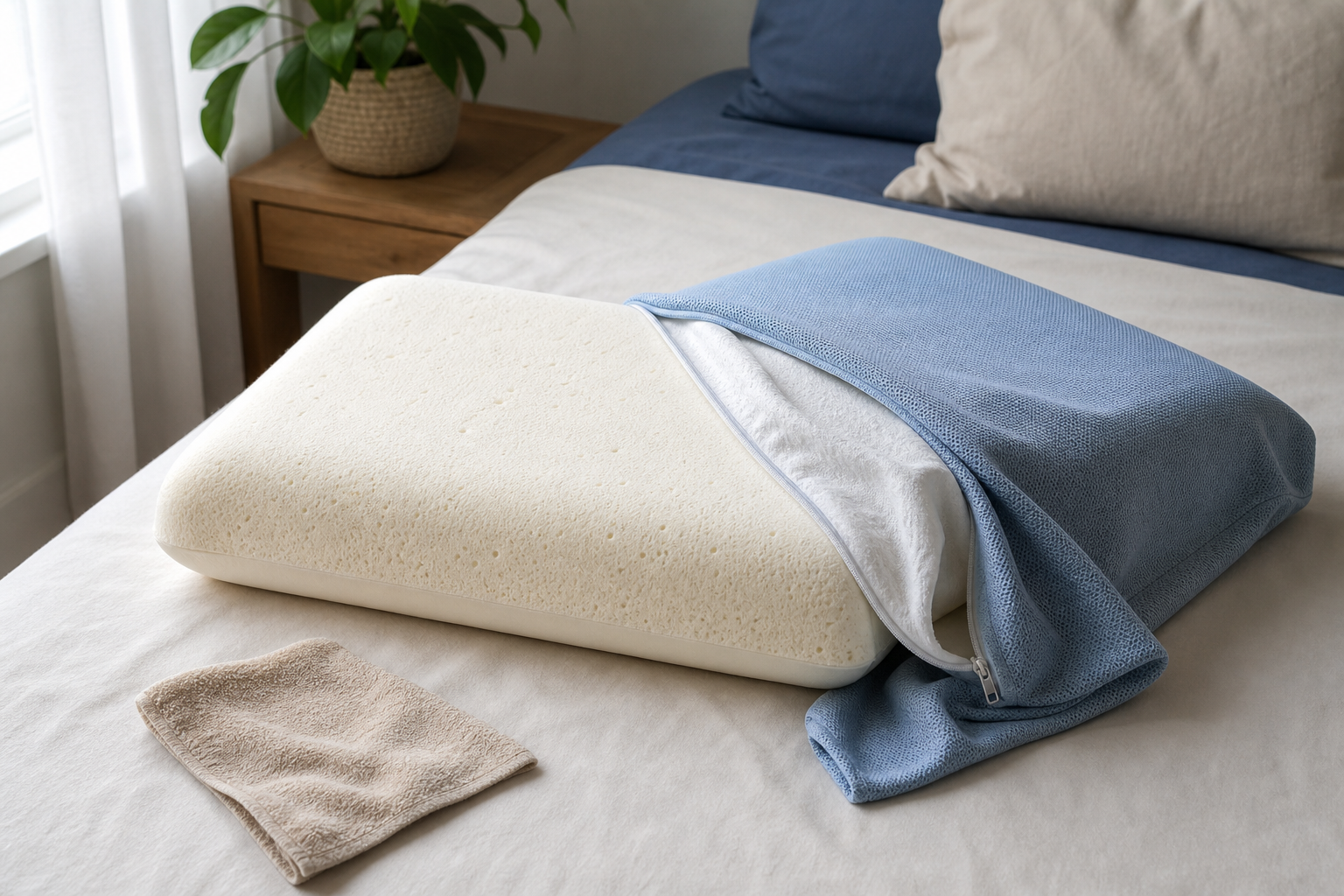
Do not put an entire memory foam pillow in the washing machine unless the care instructions for that exact pillow say you can. A removable cover and the foam core often have separate cleaning rules, so you need to identify each component before adding water or cleaner.
Quick answer: Wash a removable cover only as its label directs. Clean the foam core only by the method its manufacturer permits, then let every component complete the directed drying process before reassembly.
The safest process depends on the pillow’s construction and whether you are dealing with ordinary cover dirt, a small surface mark, a deeper spill, or suspected mold.
Good memory foam pillow care starts by treating the cover and foam as separate components. To clean memory foam pillow surfaces safely, use only the method allowed for that exact model rather than assuming every foam pillow can tolerate water.
Check the Label Before You Wash Anything
Look for care information on the outer cover, the pillow itself, and any inner layer. A washable cover does not automatically mean the memory foam core is washable.
Some pillows contain solid foam, while others use shredded fill, gel layers, bonded pieces, inserts, or specialty fabrics. A zipper also does not prove that a layer is designed to be removed. Taking apart the wrong component could damage the pillow or make it difficult to reassemble correctly.
If the label is missing or unreadable, look for current instructions using the manufacturer, exact product name, model, and construction. Do not substitute generic memory foam advice if you cannot confidently identify the pillow. Contact the manufacturer when necessary.
How to Wash a Memory Foam Pillow Safely
1) Remove the bedding and inspect the construction.
Take off the pillowcase. Identify the removable outer cover, any inner liner, and the foam or fill. Remove only the parts that the product instructions say are removable.
2) Classify the cleaning problem.
Check whether the dirt is limited to the cover, appears as a small surface spot on the foam, or comes from a spill that penetrated the core. Also look for dampness, suspected mold, cracking, crumbling, tearing, or foam that is no longer returning to its intended shape.
3) Read the instructions for each component.
Confirm the permitted washing method for the cover and the separate cleaning method for the core. Pay attention to restrictions involving washing machines, immersion, cleaners, agitation, squeezing, heat, and machine drying.
4) Clean the removable cover as directed.
If the cover is washable, follow its own label for washing and drying. Do not invent a water temperature, detergent amount, or machine setting. A fabric cover may tolerate a process that would not be suitable for the foam underneath.
5) Clean the foam only by its approved method.
If the manufacturer permits spot cleaning, follow the specified products and process, keeping the treatment limited to the affected area. Do not assume that hand washing, soaking, steaming, or using a familiar household cleaner is safe. If full washing is not expressly authorized, do not improvise it.
6) Complete the directed drying process.
Follow the pillow’s instructions rather than relying on a universal number of hours. Before reassembly, confirm that no cleaned area feels damp and that moisture is not trapped beneath a cover or liner. Do not sleep on the pillow while any component remains damp.
What Not to Do to the Foam Core
Unless the instructions for your exact pillow expressly permit it:
- Do not apply the cover’s washing directions to the foam.
- Do not put the core in a washing machine or tumble dryer.
- Do not soak, wring, twist, or aggressively squeeze the foam.
- Do not use steam, direct heat, or an unapproved cleaner.
- Do not replace the cover while the foam is still damp.
These actions can affect the foam, its shape, or the pillow’s other materials. They can also make it harder to determine whether moisture remains inside the core.
When Routine Cleaning May Not Be Enough
A mark on a removable cover is different from liquid that has soaked deeply into foam. If the core is saturated, cannot be dried as directed, or has visible signs of suspected mold, routine surface cleaning may not be appropriate.
Do not assume a soaked pillow can always be restored at home. Likewise, a stale odor does not prove that mold or another contaminant is present, and a pillow is not necessarily safe simply because it looks or smells clean. Ask the manufacturer what the exact product can tolerate and whether it should remain in use.
Cleaning also cannot repair foam that is cracking, crumbling, tearing, or otherwise deteriorating. Stop experimenting if the permitted method cannot address the problem without further damaging the pillow.
The Practical Takeaway
Treat the cover and foam core as separate items. Follow the care instructions for each, choose the least aggressive permitted cleaning method, and reassemble the pillow only when every component has completed the directed drying process. If full washing is not specifically authorized, do not attempt a full wash.