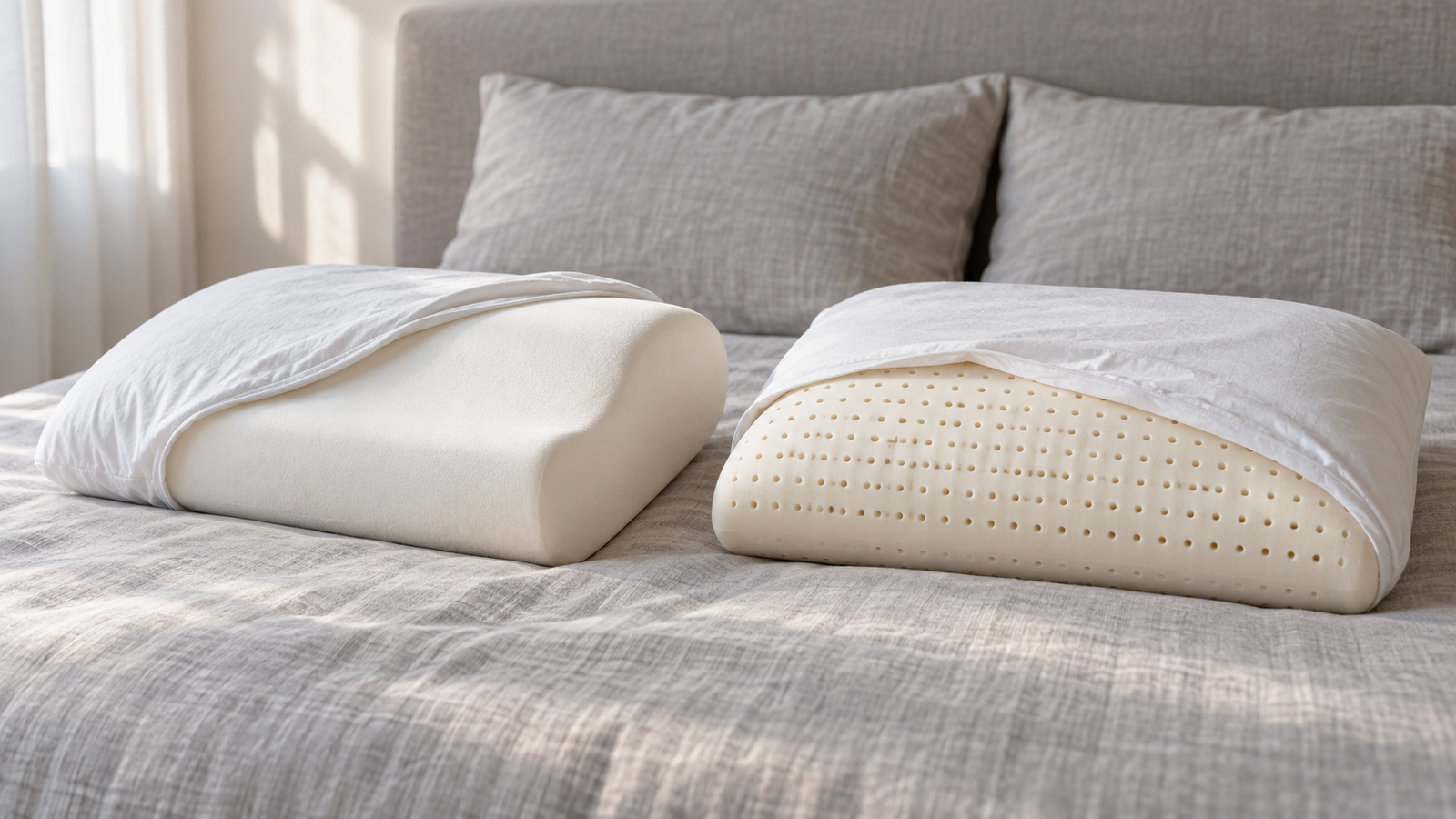
Choosing a memory foam vs latex pillow starts with one question: do you want your head to settle into a close-fitting cradle, or rest on something springier?
Memory foam commonly contours more slowly and closely. Latex usually responds faster, with a bouncier feel. Neither sensation suits everyone.
But feel only gets you halfway. Temperature, pillow height, care instructions, and personal comfort also matter, and two pillows made from the same material can feel surprisingly different.
Here’s what to compare before you choose.
Memory Foam vs Latex Pillow: Quick Comparison
| What you notice | Memory foam | Latex |
|---|---|---|
| Feel | Close contouring | Springier cushioning |
| Response when you move | Commonly slower | Usually faster |
| Starting point if you prefer… | A settling-in sensation | A buoyant sensation |
These are broad tendencies, not promises about every pillow. Both materials come in different firmness levels.
Compare the Feel: Contouring or Springy?
Think about what happens when you rest your head on the pillow, and when you turn over. These are the two sensations to compare.
Memory foam: for a closer cradle
Start here if your ideal pillow lets you settle into one comfortable spot.
When trying one, stay in your normal sleeping position for several minutes. Then turn your head. Do you enjoy the way it cradles you, or wish it moved with you more readily?
Try it if: you like the slow-contouring sensation described in the comparison above.
Latex: for a quicker response
Start here if you dislike a lingering indentation when you change positions.
A solid latex pillow can provide a consistent, springy surface. For example, Naturepedic describes its molded latex model as firm and responsive, with a single core that keeps its shape. That describes this particular design, not every latex pillow.
Try it if: you prefer a little bounce when you shift your head.
Memory Foam vs Latex Pillow Temperature: Which Sleeps Cooler?
Latex generally has the edge on airflow, while memory foam can retain more heat. However, the finished pillow’s construction matters.
Before buying, check:
- Ventilation: Does the pillow have airflow channels or a perforated core?
- Cover: What fabric will sit beneath your pillowcase?
- Return terms: Can you test its temperature comfort overnight?
Naturepedic’s solid latex model, for example, uses a perforated core to encourage airflow. That is a specific feature you can look for when comparing products.
Treat “cooling” as a feature to investigate, rather than a guarantee you’ll never flip your pillow again.
Check Pillow Height Before Choosing the Material
Ask how tall the pillow feels with your head on it. The listed height alone doesn’t tell you how much it compresses.
During a trial, pay attention to your usual position:
- On your side: Does your head feel tipped toward the mattress or lifted away from it?
- On your back: Does the pillow push your chin toward your chest?
- On your stomach: Does the height make your head feel awkwardly raised?
Use those observations to compare heights and shapes. Don’t assume the most expensive material will fix a poor fit.
If you’re unsure, look for a model that explicitly allows height adjustment. Check how adjustment works before ordering; a zippered cover alone doesn’t mean you can remove filling.
Compare Care Instructions: What Can You Actually Wash?
A washable cover doesn’t mean a washable pillow.
Solid memory foam generally cannot go in the washing machine. Some shredded foam designs have different instructions, so read the label for the exact model.
Check latex instructions just as carefully. Naturepedic specifies spot cleaning and complete drying for its solid latex pillow.
Before checkout, confirm:
- Whether the cover comes off.
- Whether you can machine-wash that cover.
- How to clean the inner pillow.
- How to dry it safely.
If easy care matters to you, make this part of your shortlist from the start.
Which Pillow Should You Choose?
Use your current pillow as a clue. What bothers you most: its feel, its height, heat, or cleaning?
Shortlist memory foam if close contouring sounds comfortable. Shortlist latex if you prefer a springier response. Then compare individual models for height, construction, and care.
Before paying, read the return policy carefully. Look for whether it accepts opened, slept-on pillows, how long you have, and any return costs.
Your final check: “Do I like this pillow under my head, in my own bed?” That matters more than which material wins a general comparison.