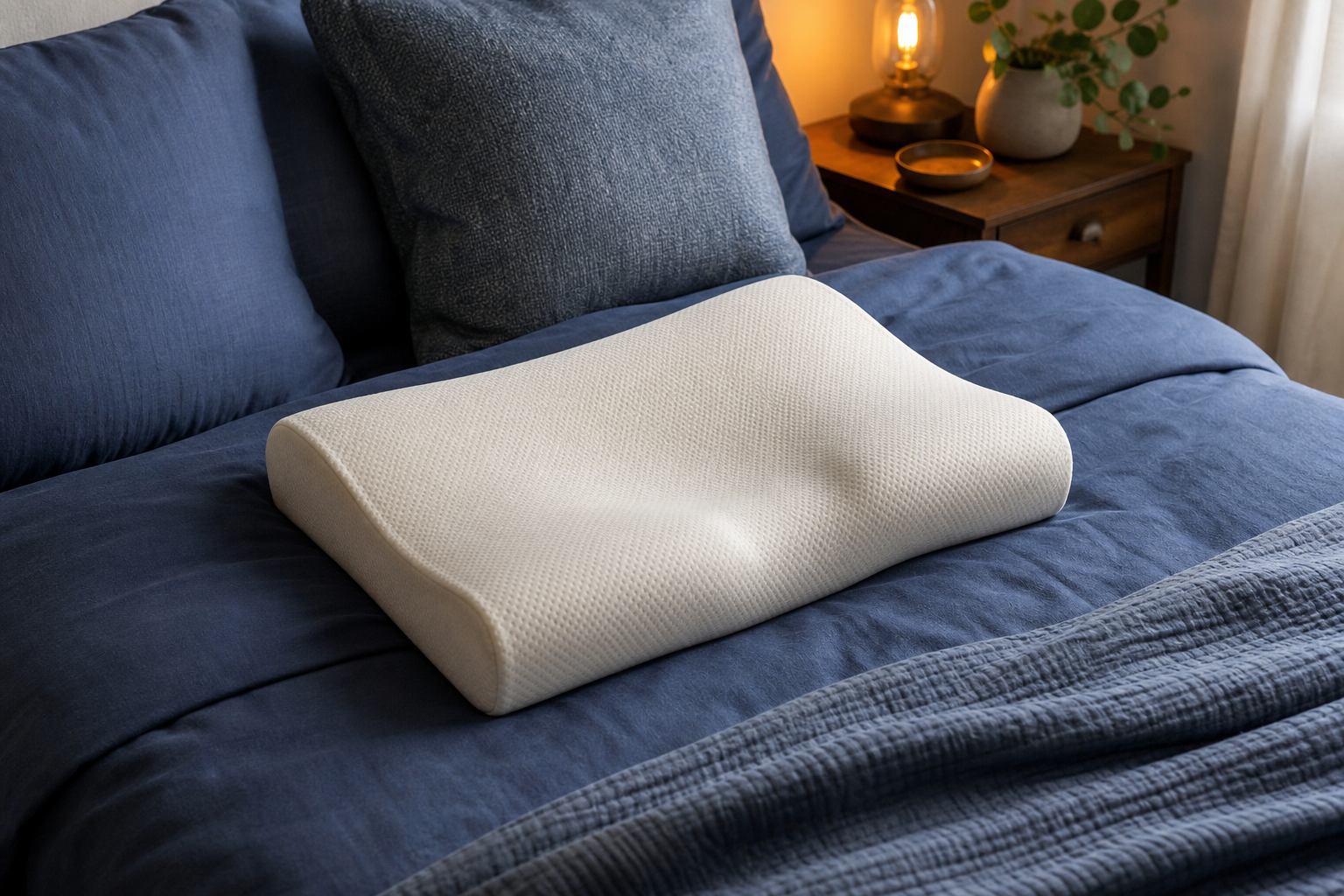
A contour pillow should support your head and neck in the zones intended by its manufacturer. However, there is no universal rule that the high edge always belongs under your neck or that back sleepers must use the low edge.
Quick answer: Check the instructions for your specific pillow, identify its neck-facing edge and head area, and then test an allowed orientation in your normal sleeping position. Choose the permitted setup that supports your head without noticeably tilting it up, down, forward, or backward.
Why Contour Pillow Orientation Varies
Unlike a conventional loose-fill pillow, a contour pillow may have raised edges, a center cradle, shoulder cutouts, side wings, or several molded resting areas. These features do not have standardized meanings across every pillow.
Some models can be rotated to provide two neck-support heights. Others have one fixed neck-facing direction because of their asymmetrical shape. A shoulder cutout or wing can also change where your body is meant to rest.
Do not assume the tallest curve automatically goes under your neck. Labels, packaging diagrams, cover seams, and the current manufacturer guide are more reliable than appearance alone.
High Side or Low Side of Contour Pillow?
If rotation is allowed, compare both heights in your usual position. If the maker specifies only one neck-facing edge, follow that direction instead.
How to Use a Contour Pillow in 6 Steps
- Prepare the pillow as directed.
If the pillow arrived compressed, follow its model-specific unpacking, ventilation, and expansion instructions. Do not judge the final height until the stated preparation process is complete.
- Identify the intended orientation.
Find the designated neck-facing edge, head cradle, shoulder area, and any position-specific zones. Check whether the manufacturer permits rotation between different contour heights.
- Place your head and neck in the correct zones.
Your neck should rest on the supporting curve, with your head settling into the intended head area. Follow the model’s directions about shoulder placement rather than applying a universal shoulders-on or shoulders-off rule.
- Lie in your complete sleeping position.
Do not test the pillow while sitting up or turning only your head. Settle onto your side or back as you would at night. If you normally use a pillow between your knees when side sleeping or beneath your knees when back sleeping, include it during the test.
- Check your position and comfort.
Your head should look comfortably centered rather than sharply tilted. Notice pressure, unsupported gaps, chin crowding, or the feeling that you must hold your head in place. A photo taken by someone else can reveal an obvious tilt, but it cannot diagnose an alignment or medical problem.
- Compare another permitted setup if needed.
If your pillow is designed to be rotated, test the other approved contour height. Change one thing at a time so you can tell whether the alternative improves the fit.
Contour Pillow Fit for Side Sleepers
When you lie on your side, your shoulder creates space between the mattress and the side of your head. The pillow needs enough effective height to fill that space without lifting your head toward the ceiling.
Check that:
- your head is not dropping toward the mattress
- your head is not being pushed noticeably upward
- your neck rests on the contour instead of hanging beyond it
- your shoulder is positioned as the pillow’s design requires
Side sleepers often need more effective loft than back sleepers, but this does not mean every side sleeper should use the highest contour. A soft mattress can let your shoulder sink farther, reducing the height needed. Pillow compression and body proportions also change the result.
Contour Pillow Fit for Back Sleepers
For a back-sleeping test, face comfortably upward instead of turning your head sharply to one side. The contour should support your neck without forcing your head into an exaggerated forward or backward angle.
Check that:
- your chin does not feel crowded toward your chest
- your head does not feel as though it is falling backward
- your neck contacts the intended curve without intense pressure
- your head rests in the cradle rather than on a ridge
Back sleepers frequently prefer less effective height, but the lower contour is not automatically correct. It can still be too low if the foam compresses substantially or the shape does not suit your proportions.
What If You Switch Between Side and Back Sleeping?
A setup that fits on your back can feel too low on your side, while one that fills the side-sleeping gap can push your head forward when you roll onto your back.
Combination sleepers should test every commonly used position. Whether one orientation provides a workable compromise depends on the pillow’s shape, permitted uses, compression, and how deeply the mattress allows the body to sink. If neither approved orientation works in both positions, the pillow may simply be a poor fit for your sleeping pattern.
Signs You Should Change the Setup
Recheck the instructions or try another manufacturer-permitted orientation if you notice:
- obvious upward, downward, forward, or backward head tilt
- concentrated pressure from a ridge
- an unsupported gap beneath the neck
- repeated slipping out of the intended head area
- numbness, tingling, or new discomfort
- symptoms that become worse with continued use
A new molded shape can feel unfamiliar, but you should not push through pain on the assumption that discomfort proves the pillow is working.
The Practical Takeaway
The manufacturer’s instructions determine which contour pillow orientations are intended. Your full-position fit check determines which permitted setup works best for you.
Stop using an arrangement that causes new or worsening discomfort. Persistent or severe pain, numbness, weakness, breathing concerns, or ongoing sleep difficulty should be discussed with a qualified healthcare professional rather than addressed with a pillow alone.