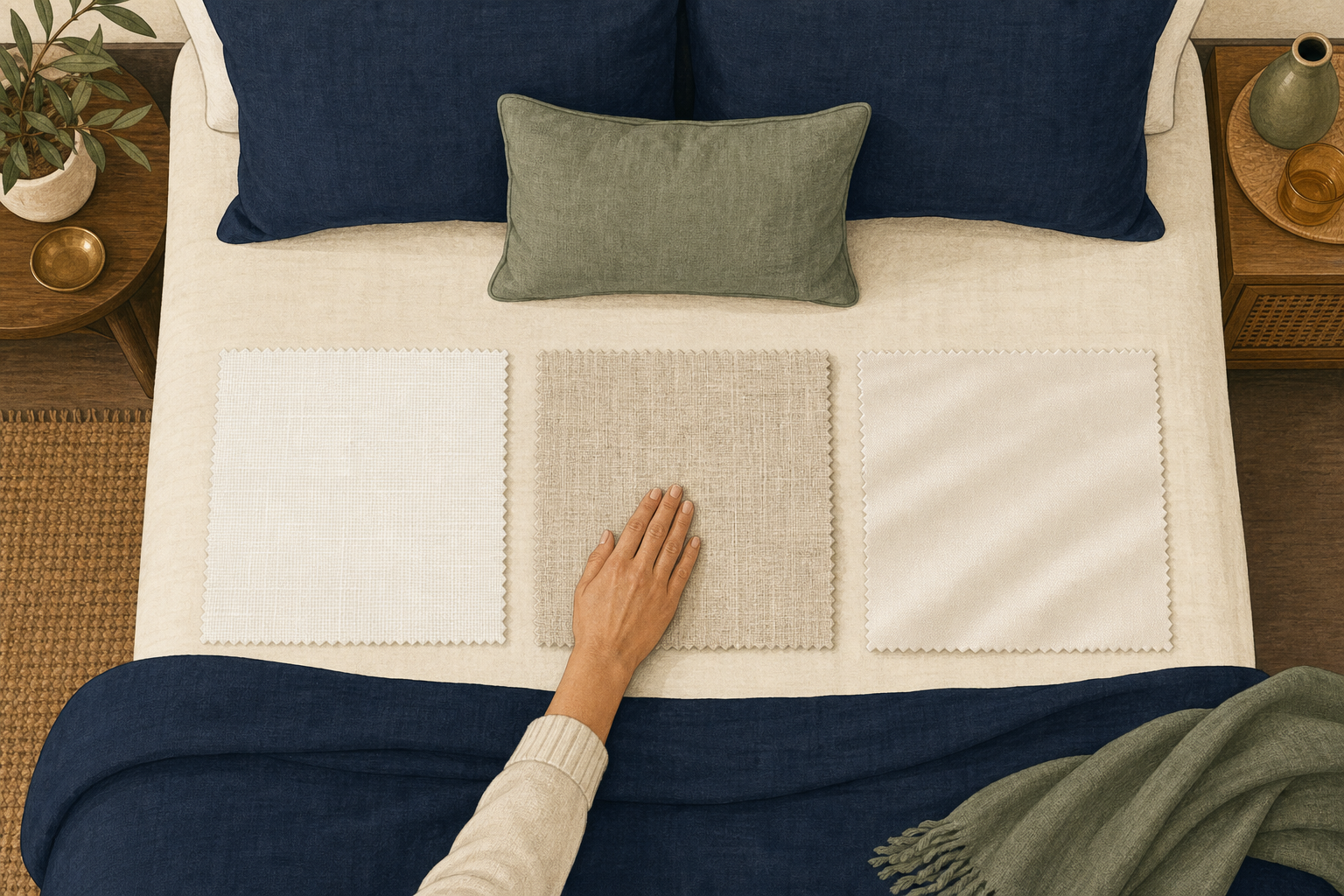
The best sheets for hot sleepers are usually lightweight, unbrushed, and comfortable against bare skin. Cotton percale and linen are useful starting points, but fiber alone does not determine how a sheet feels. Weave, fabric weight, finishes, fit, and the rest of your bedding also matter.
Instead of looking for one universally “cooling” material, compare how the sheet is constructed and decide whether you prefer a crisp, smooth, or textured surface.
Quick answer: Start with a lightweight cotton percale or linen sheet. Check the actual fiber label, avoid heavy or brushed constructions, and treat thread count and “cooling” language as secondary to weave, weight, and feel.
What Actually Makes a Sheet Feel Cooler?
Several fabric properties affect nighttime comfort. No single feature guarantees that a sheet will stay cool all night.
Air permeability describes how readily air can pass through a fabric. Fiber type matters, but yarn size, weave, fabric density, and finishing treatments can change permeability substantially.
Fabric weight and thickness affect how much material rests around you. A lightweight sheet may feel less enclosing than a thick, dense one, even when both are made from the same fiber.
Surface feel determines the first sensation against your skin. A fabric can feel cool at initial contact without necessarily releasing heat or moisture better throughout the night.
Drape and cling also matter. Some sleepers like a smooth sheet that follows the body, while others find close-draping fabric too enclosing and prefer a crisp sheet that tents slightly away from the skin.
This is why two sets labeled “100% cotton” can feel completely different.
Compare the Main Sheet Fabrics
Use fiber content to narrow your options, then inspect the weave and weight before deciding.
Cotton
Cotton is widely available, washable, and produced in many constructions. It can create a crisp, lightweight sheet or a dense, silky one, so the word “cotton” alone tells you very little about sleeping temperature.
For a warm sleeper, cotton percale is often the most practical place to begin. Its plain-weave construction typically produces a matte, crisp surface. It may feel slightly stiff when new but often relaxes with laundering.
Cotton sateen feels smoother and more fluid. Some hot sleepers enjoy that softness, while others find a dense sateen sheet more enclosing. Choose based on the complete fabric rather than assuming all cotton performs alike.
Linen
Linen commonly has a textured surface and relaxed drape. Many linen sheets use relatively substantial yarns without creating the slick, closely packed feel associated with some high-thread-count fabrics.
Linen can be a good option if you want an airy-feeling sheet and do not mind visible wrinkles or texture. New linen may feel firm or coarse compared with smooth cotton, although its hand can change with repeated washing.
Check the weight if the manufacturer provides it. Linen is not automatically lightweight, and a heavy linen sheet may not suit someone looking for the least possible fabric around the body.
Lyocell, Rayon, and Viscose
Lyocell, rayon, and viscose sheets often feel smooth, soft, and drapey. That can be appealing if crisp percale or textured linen irritates your skin.
These names describe manufactured fibers, but the finished fabric’s weave and weight still shape its performance. Do not assume every lyocell or viscose sheet has identical temperature or moisture properties.
Be especially careful with sheets marketed simply as “bamboo.” Soft bamboo-derived bedding is commonly rayon or viscose made using bamboo as the plant source. Read the required fiber-content label to learn what the fabric actually contains rather than relying on the larger marketing language.
Polyester and Blends
Polyester sheets are often durable, wrinkle-resistant, and quick to dry after washing. Their feel varies considerably depending on yarns, weave, and finishing.
A dense microfiber sheet may feel soft but too enclosing for some hot sleepers. Cotton-polyester blends can be lighter and easier to maintain than expected, so they should not be rejected solely because they contain a synthetic fiber. Touch the fabric when possible and prioritize construction over broad material rules.
Silk
Silk has a smooth surface and distinctive drape, but it is not automatically the best choice for sleeping warm. Price, care requirements, fabric weight, and personal preference all matter.
Choose silk primarily because you enjoy its feel and are comfortable following its care instructions, not because you expect a guaranteed cooling effect.
Choose the Right Weave for Sheets for Hot Sleepers
Weave describes how yarns cross to form the fabric. It can be as important as fiber content.
Percale uses a plain-weave structure and usually feels crisp, matte, and relatively structured. It is a strong first choice if you dislike sheets clinging closely to your body.
Sateen uses longer yarn floats at the surface, producing a smoother feel and subtle sheen. It tends to drape more closely than percale. A lightweight sateen may still be comfortable for a hot sleeper, but a thick, densely constructed set may feel warmer.
Jersey is knitted rather than woven. It feels soft and stretchy, much like a T-shirt. The stretch can help with mattress fit, but jersey may cling or bunch more than crisp woven sheets. Its comfort depends heavily on fabric weight and your preference for a close, soft feel.
Flannel and brushed fabrics have a raised, fuzzy surface intended to create a warmer hand. They are usually less suitable when your priority is reducing an insulated or cozy feeling.
A useful shortcut is to choose percale for crispness, linen for texture, sateen for smoothness, or jersey for stretch. Then look for the lightest version that still feels comfortable and durable enough for regular use.
Do Not Shop by Thread Count Alone
Thread count generally refers to the number of lengthwise and crosswise threads in a square inch of woven fabric. It does not measure every quality that affects comfort.
Very high numbers can result from fine multi-ply yarns, dense construction, or counting methods that make comparison difficult. More threads can also mean more material packed into the same area, which may not be what a hot sleeper wants.
Rather than chasing the largest number:
- Check the fiber-content label.
- Identify the weave.
- Look for fabric weight or lightweight descriptions.
- Avoid assuming that a four-digit thread count is superior.
- Compare return or trial policies when buying without touching the fabric.
A well-made, moderate-thread-count percale may suit you better than a heavier sheet promoted mainly through an impressive number.
Use a Simple Buying Checklist
Before ordering, answer these questions:
- What is the exact fiber content? Read the label rather than relying on names such as natural, eco, or bamboo.
- What is the weave or construction? Look for percale, sateen, linen weave, jersey knit, flannel, or another specific description.
- Does the fabric sound light or dense? Weight and thickness can be more informative than an extreme thread count.
- What texture do you tolerate? Decide whether you prefer crisp, silky, stretchy, or visibly textured sheets.
- Will the fitted sheet fit correctly? Measure the mattress with its protector or topper in place.
- Can you follow the care instructions? A sheet that requires inconvenient care may not remain part of your regular rotation.
- Can it be returned after inspection or trial? Feel is subjective, particularly when buying sheets online.
Wash new sheets according to the current care label before making a final judgment if the return policy allows laundering. Manufacturing finishes and packaging can affect the initial hand, and some fabrics relax after washing.
Test the Whole Bed, Not Just the Sheets
Sheets are only one layer in your sleep environment. A waterproof protector, thick mattress topper, heavy duvet, plush blanket, or heat-retaining sleepwear may have a larger effect than changing between two similar sheet sets.
If new sheets do not make enough difference, simplify the setup for a few nights:
- Try a lighter blanket or duvet.
- Remove unnecessary decorative layers.
- Check whether the mattress protector feels stiff or nonporous.
- Wear lighter sleep clothing.
- Adjust room temperature and airflow where practical.
Change one element at a time so you can tell what actually improves comfort.
The Practical Takeaway
For most hot sleepers, lightweight cotton percale is the safest first experiment, while linen is worth considering if you enjoy texture and a relaxed feel. Smooth lyocell, rayon, viscose, or sateen may also work, but construction matters more than the material name.
Read the fiber label, favor an unbrushed and reasonably lightweight fabric, and choose the surface feel you can comfortably sleep against. If overheating or drenching night sweats are persistent, new, or accompanied by other concerning symptoms, discuss them with a qualified healthcare professional rather than relying on bedding changes alone.