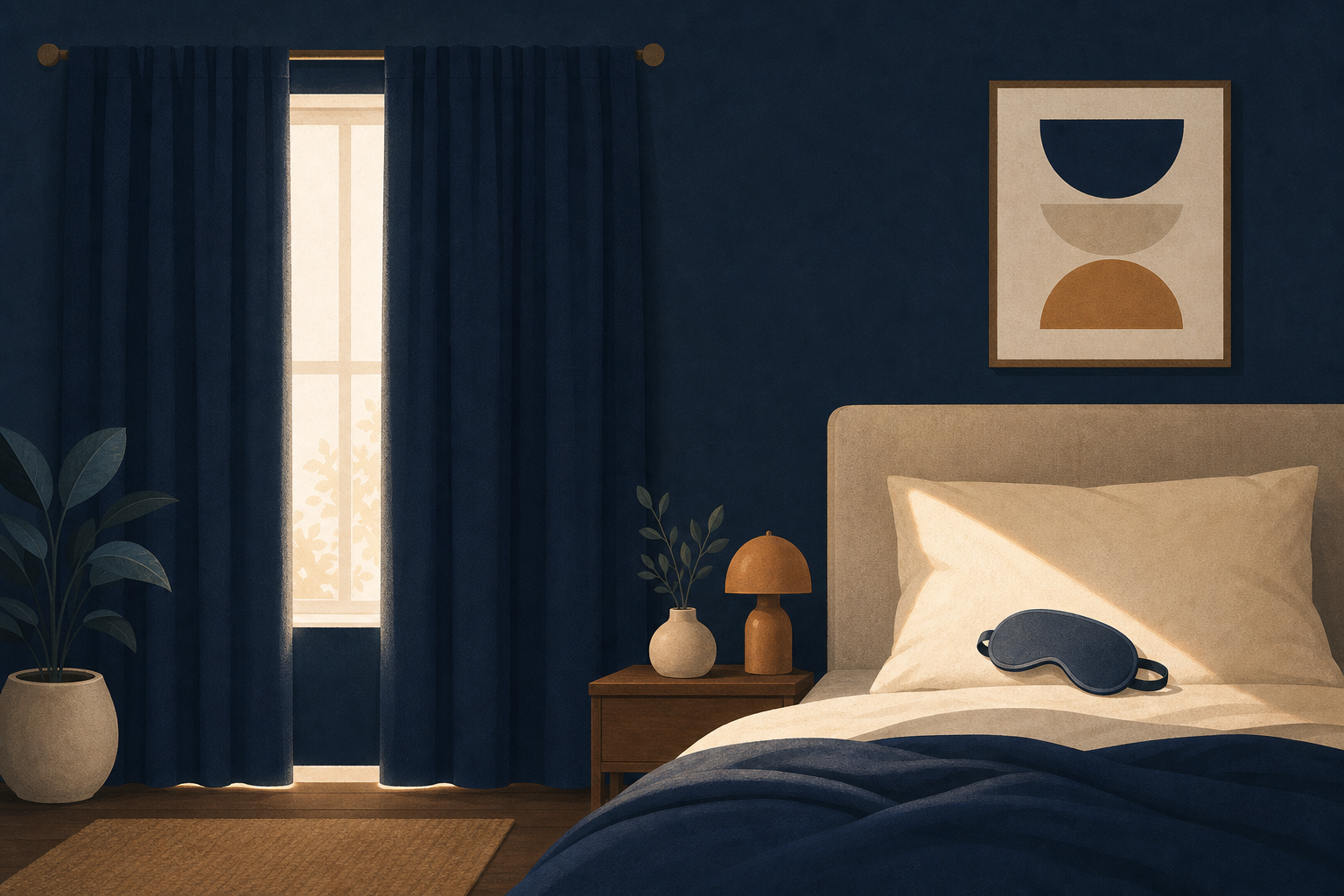
Choose blackout curtains when you want the entire bedroom darker and can cover the windows properly. Choose a sleep mask when you need a portable, renter-friendly option or share the room with someone who prefers more light. Neither is universally better. The right choice depends on where the light comes from, whether you tolerate something touching your face, and how much installation you can manage.
Quick answer: Blackout curtains change the room, while a sleep mask covers your eyes. Curtains usually suit permanent bedrooms and window light. Masks suit travel, rentals, shared rooms, and light leaks that are difficult to eliminate.
A dark bedroom is a common part of general sleep-hygiene guidance, but achieving it is not always as simple as buying fabric labeled “blackout.” Curtain placement, window shape, mask fit, sleeping position, and nighttime routines can all affect the result.
Blackout Curtains vs Sleep Mask at a Glance
The basic difference is the area each option controls.
Blackout curtains:
- Reduce light entering through a covered window
- Darken the room for everyone
- Require measuring and some type of installation
- Leave your face uncovered
- Stay in the bedroom
- May still allow light around the top, sides, or bottom
A sleep mask:
- Blocks light at your eyes rather than at the window
- Works without changing the room for anyone else
- Requires no permanent installation
- Can be packed for travel
- Must feel comfortable against your face and head
- May shift as you change position
If several windows, a glass door, a skylight, or a bright hallway are involved, covering every source may be difficult. A well-fitting mask can bypass those room-level problems. If you strongly dislike facial pressure or tend to remove wearable items while sleeping, curtains are likely to be easier.
When Blackout Curtains Fit Better
Blackout curtains are the more complete bedroom change. They are a strong starting point when early sunlight, a streetlamp, or exterior lighting regularly enters through the same window.
They may fit you better if:
- You sleep in the same bedroom most nights.
- You want the room dark before getting into bed.
- More than one person wants darkness.
- You sleep during daylight hours.
- Masks feel warm, restrictive, or distracting.
- You want window coverage that also provides privacy.
Curtains let you move around in a darkened room without wearing anything. That can be useful if you read, stretch, or complete a quiet bedtime routine before getting into bed.
Their main weakness is edge leakage. Opaque fabric can cover the center of a window while bright lines remain around it. A narrow curtain that hangs far from the wall may provide less darkness than expected.
For better coverage, inspect:
- Width: The panels should cover the window and extend beyond its sides when closed.
- Height: Check for light entering above the rod or below the fabric.
- Center overlap: Two panels can separate slightly where they meet.
- Distance from the wall: Large gaps allow light to spill around the edges.
- Other sources: Curtains will not block charging lights, alarm displays, door gaps, or light from adjoining rooms.
“Blackout” can describe different constructions and levels of performance. Review current manufacturer information for the particular curtains, liner, rod, or mounting system you are considering rather than assuming every product blocks the same amount of light.
When a Sleep Mask Fits Better
A sleep mask is a personal solution rather than a room renovation. It can be especially practical when you cannot control the windows or do not want the bedroom dark for everyone.
A mask may fit you better if:
- You rent and cannot drill into walls.
- You travel frequently.
- Your partner wakes earlier or uses a reading light.
- You sleep in different rooms or locations.
- You want to test whether darkness is useful before changing the room.
- Light enters from several directions.
- Your current curtains are adequate except for a few stubborn leaks.
The advantage is simplicity. You do not need to measure windows, match curtain lengths, move furniture, or obtain permission from a landlord.
Comfort is the deciding factor. A mask that blocks light well but feels distracting is unlikely to become an easy part of your routine. Fit can change with head size, strap design, fabric, pillow contact, and sleep position.
When trying a mask, check that:
- The strap feels secure without creating uncomfortable pressure.
- The mask does not pinch the bridge of your nose.
- You can blink comfortably.
- The edges do not create distracting gaps near your nose.
- Side hardware does not press between your head and pillow.
- The mask stays reasonably stable when you roll to each side.
Follow the manufacturer’s current washing and care instructions. Stop using a mask that causes irritation, uncomfortable pressure, or worsening skin discomfort.
Installation and Rental Constraints
Curtains require more planning, but renters do not always have to choose a mask. The available options depend on the window, curtain weight, wall surface, and rental rules.
Possible approaches include:
- Using an existing curtain rod
- Adding removable blackout liners to current curtains
- Choosing a tension-mounted setup where appropriate
- Using removable window coverings designed for temporary installation
- Requesting permission for a properly mounted rod
Do not assume an adhesive hook or tension rod can safely support heavy fabric. Check the mounting system’s instructions, weight limits, and surface requirements. Keep cords, loose fabric, and hardware arranged safely, especially in homes with children or pets.
A mask remains the simplest choice when the rental period is short, the windows are unusually shaped, or temporary coverings would be inconvenient to remove each morning.
Comfort, Shared Rooms, and Morning Light
Your preferred wake-up environment matters as much as nighttime darkness.
Blackout curtains can keep the room dark after sunrise, which may be useful for daytime sleepers or late schedules. They can also make it harder to notice natural morning light until you open them. If morning daylight is part of your routine, plan to open the curtains soon after waking.
A sleep mask allows the room to brighten naturally while your eyes remain covered. You can remove it when you are ready to get up. This may suit couples with different schedules, although a partner’s bright lamp or screen can still be disruptive before you put the mask on.
Consider nighttime movement as well. A very dark room can make trips to the bathroom less convenient. Keep floors and walkways clear. If you need visibility for safe movement, a dim, carefully placed night-light may be more practical than complete room darkness.
Try This Bedroom Darkness Test
Before buying anything, spend ten minutes identifying the actual problem.
- Lie down at your normal bedtime. Judge the room from pillow level, not while standing by the window.
- Wait for your eyes to adjust. Small light sources may become more noticeable after several minutes.
- Identify each source. Check windows, door gaps, electronics, clocks, chargers, and hallway light.
- Notice the direction. Window light points toward curtains. Scattered or shared-room light may point toward a mask.
- Turn onto each sleeping side. A light that disappears in one position may shine directly toward you in another.
- Test a temporary change. Cover or switch off small electronic lights, close door gaps where practical, or try a comfortable mask before committing to new window hardware.
- Recheck near sunrise. A room that looks dark at bedtime may become bright early in the morning.
This test helps prevent buying heavy curtains when one small electronic light is the real issue. It can also reveal that a mask alone will not provide the room-level darkness or privacy you want.
Can You Use Both?
Yes. Curtains and a sleep mask solve different parts of the same problem, so they can work together.
Curtains can reduce most window light and create a generally dark bedroom. A mask can cover the remaining glow around curtain edges, under a door, or from devices that cannot be switched off. This combination may be practical for shift workers, highly light-sensitive sleepers, or bedrooms with difficult window shapes.
You do not need both by default. Start with the option that addresses the largest and most consistent light source. Add the second only if remaining light is still bothersome and the extra step feels worthwhile.
The Practical Choice
Pick blackout curtains if the window is the main problem, everyone wants a darker room, and you prefer not to wear anything on your face.
Pick a sleep mask if you rent, travel, share the bedroom with someone on another schedule, or need a fast way to block light from several directions.
Choose both when well-installed curtains still leave noticeable leaks and you find a mask comfortable.
Darkness is one part of a supportive sleep environment, not a treatment for ongoing sleep problems. If you regularly struggle to fall asleep, stay asleep, or remain alert during the day despite allowing enough time for rest, discuss the pattern with a qualified healthcare professional.