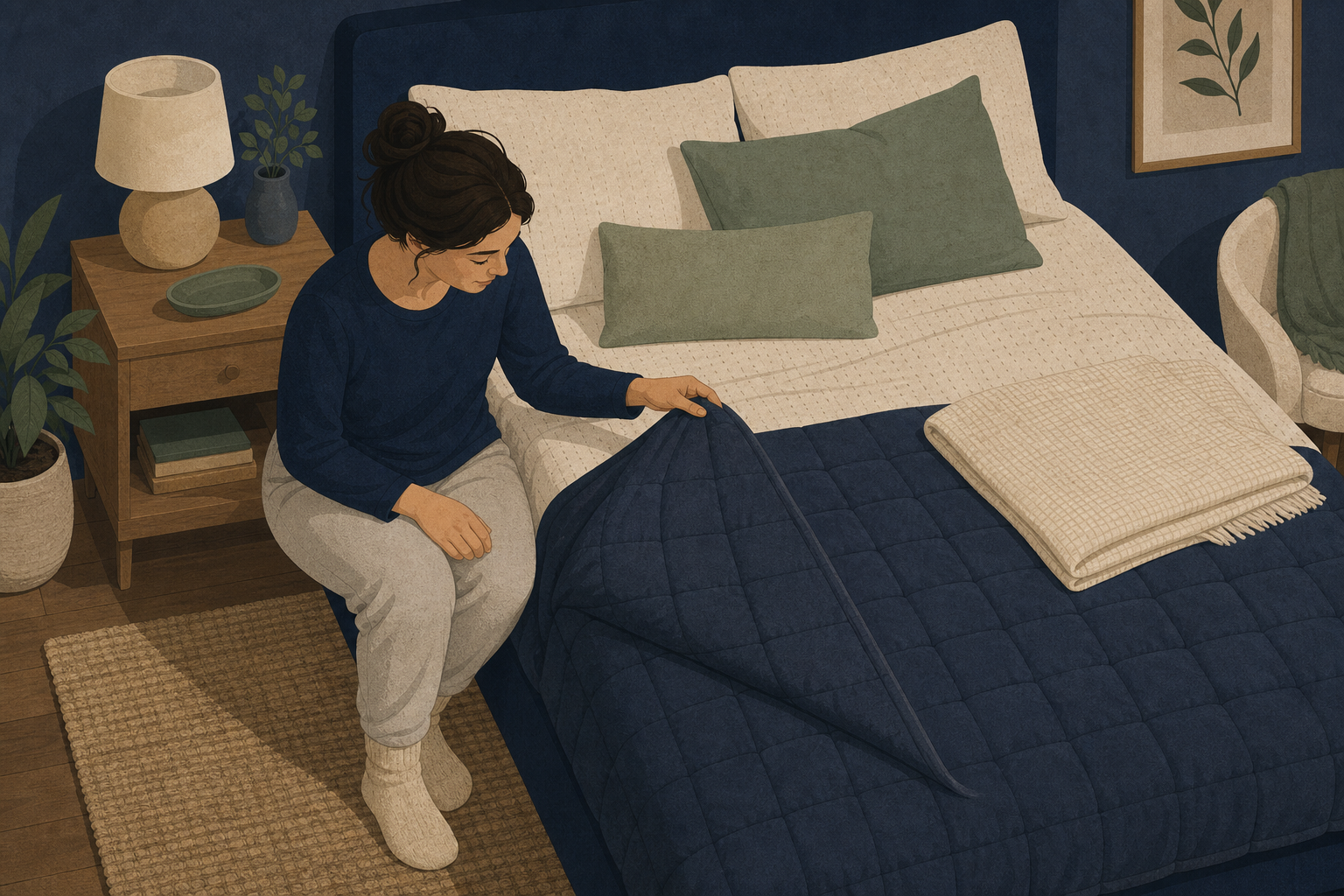
Weighted blankets may feel calming or comfortably substantial to some adults, but they are not guaranteed to improve sleep. Before buying one, check whether you can move and remove it easily, how its weight is distributed, whether the fabric will trap heat, and what the manufacturer says about sizing and safe use. Treat the familiar body-weight percentage as a starting point, not a universal formula.
Quick answer: Choose the lightest weighted blanket that provides the pressure you enjoy while still letting you turn, uncover yourself, and get out of bed without difficulty.
What the sleep evidence actually shows
Research into weighted blankets for sleep is promising in places but still limited. Some adult studies have found improvements in self-reported sleep quality or insomnia symptoms, particularly in selected clinical groups. Other findings are smaller, mixed, or not confirmed by objective sleep measurements.
That means a weighted blanket is best viewed as a comfort preference rather than a proven treatment. It may make your bed feel more settled and secure, do nothing noticeable, or feel restrictive and unpleasant.
If poor sleep is persistent, significantly affects daytime functioning, or occurs with breathing concerns or prolonged daytime sleepiness, speak with a qualified healthcare professional rather than relying on heavier bedding.
Do not rely on the 10 percent rule alone
Many weighted blanket labels and buying guides suggest choosing a blanket equal to about 10 percent of your body weight. This is a widely repeated rule of thumb, but it is not a precise formula that identifies the ideal or safe weight for every sleeper.
Your experience also depends on:
- the blanket’s dimensions
- how evenly the fill is distributed
- how much of the blanket rests on your body
- your mobility and strength
- your preferred sleeping position
- the thickness of your other bedding
- whether you share the bed
- your sensitivity to pressure and warmth
A 15-pound throw and a 15-pound queen-size blanket have the same total weight, but the smaller blanket may concentrate more of that weight over your body. A larger design spreads its fill across more surface area, including sections that may rest on the mattress.
Use the manufacturer’s current sizing and weight instructions as your boundary for a specific product. When two options appear suitable, the lighter one is usually the more cautious first trial.
Test your ability to move and remove it
Before sleeping under a weighted blanket, test it while you are fully awake. Lie in your usual position and perform a simple movement check:
- Roll from your back to each side.
- Pull one arm and one leg out from under the blanket.
- Push the blanket completely off your torso.
- Sit up and get out of bed.
- Repeat the test when the blanket is positioned normally, not folded over itself.
You should be able to complete every step without straining, feeling trapped, or needing another person’s help.
Do not fold a weighted blanket to create extra pressure unless its manufacturer specifically permits that use. Folding concentrates the weight over a smaller area and can make an otherwise manageable blanket feel much heavier.
The blanket should never cover your head or neck, be wrapped tightly around you, or be used as a restraint. Avoid arranging it so that substantial sections hang over the sides of the bed, since the overhanging weight can pull on the part covering you.
Check how warm the blanket may feel
Heat is one of the most practical reasons a weighted blanket does not work for a particular sleeper. The fill, shell, cover, room temperature, and bedding underneath all affect warmth.
If you sleep warm: Look for a lighter outer fabric, breathable cover, smaller dimensions, and construction that does not require a thick plush layer. Be cautious about stacking the weighted blanket over a duvet or comforter.
If you sleep cold: A warmer cover may feel pleasant, but it should not leave you sweating or unable to regulate your temperature during the night.
Product terms such as “cooling” are not standardized guarantees. Examine the listed materials and construction instead of relying only on the label. A removable cover can also let you switch fabrics between seasons.
Try the blanket without your usual comforter first. You can then add only the bedding needed for the room temperature.
Compare size before total weight
A weighted blanket does not necessarily need to cover the entire mattress. Many people find an individual-size blanket easier to manage because it places more of its weight over one sleeper and less over empty bed space.
Before buying, compare the listed dimensions with:
- your height
- the width of your usual sleeping area
- whether you want your shoulders covered
- whether you share the bed
- how much material could hang over the mattress edges
For couples, one large weighted blanket can create uneven pressure when either person moves. Separate blankets may be easier if only one person wants added weight or if the two sleepers have different temperature preferences.
Make sure the chosen size still allows the blanket to stay clear of your face and lets you uncover yourself quickly.
Inspect the construction and care instructions
Weighted blankets commonly use glass beads, plastic pellets, metal components, or layered fabric to create weight. The fill material alone does not tell you how the finished blanket will feel. Pocket size, stitching, padding, and fill movement matter too.
Check the following before buying:
- Weight distribution: Small stitched compartments can help prevent all the fill from collecting at one edge.
- Seam quality: Weak seams may allow beads or pellets to leak.
- Noise: Some fills or loosely packed pockets may shift audibly when you turn.
- Cover attachment: If there is a removable cover, internal ties or fasteners may reduce bunching.
- Care limits: A heavy blanket may exceed the capacity of a home washing machine, even if its fabric is washable.
- Drying instructions: Some materials cannot tolerate high heat.
- Damage guidance: The manufacturer should explain what to do if stitching opens or fill escapes.
- Return terms: A trial or return period is useful because pressure and heat are difficult to judge from specifications alone.
Always follow the current manufacturer instructions for use, washing, drying, storage, and weight selection. Do not continue using a blanket with leaking fill, damaged seams, broken fasteners, or severe bunching.
Know when professional guidance matters
Do not use a weighted blanket if you cannot remove it independently. Ask a qualified healthcare professional before trying one if you have a condition or medication effect that may influence:
- breathing
- circulation
- alertness
- muscle strength
- mobility
- skin integrity
- temperature regulation
The same caution applies after surgery, during an acute illness, or when weakness, numbness, or pain makes movement difficult. Stop using the blanket if it causes shortness of breath, overheating, nausea, panic, tingling, new discomfort, or restricted movement.
Weighted blankets and weighted sleepwear should not be used for infants. For an older child, do not simply apply an adult body-weight formula. Child use requires age-appropriate professional guidance, close attention to the manufacturer’s restrictions, and the ability to get out from under the blanket independently. A weighted blanket must never be used to keep a child in bed or prevent movement.
Try it gradually before using it all night
You do not have to begin with overnight use. A gradual trial makes it easier to judge pressure, temperature, and movement while you are alert.
Start with the blanket over your legs for 10 to 20 minutes while reading or relaxing. On another evening, place it over more of your body while keeping your head and neck clear. If it remains comfortable, test it in bed before deciding whether to use it for a longer period.
During the first few trials, ask:
- Can I change positions normally?
- Can I remove it without effort?
- Am I becoming warmer than usual?
- Does the pressure feel steady rather than restrictive?
- Do I actually prefer this sensation to ordinary bedding?
- Is it easier or harder to settle comfortably?
Discomfort is not something you need to “get used to.” Return to a lighter blanket or ordinary bedding if the weight makes you tense, overheated, confined, or more aware of being awake.
The practical buying takeaway
The best weighted blanket is not automatically the one closest to a percentage on a chart. It is one that follows the manufacturer’s limits, fits your sleeping area, stays at a comfortable temperature, and remains easy for you to move and remove.
Start lighter when uncertain, test it while awake, and judge it by comfort and manageability rather than promised sleep results. A weighted blanket can be an optional layer in a comfortable bedroom, but it should never compromise breathing, movement, or your ability to get out of bed.