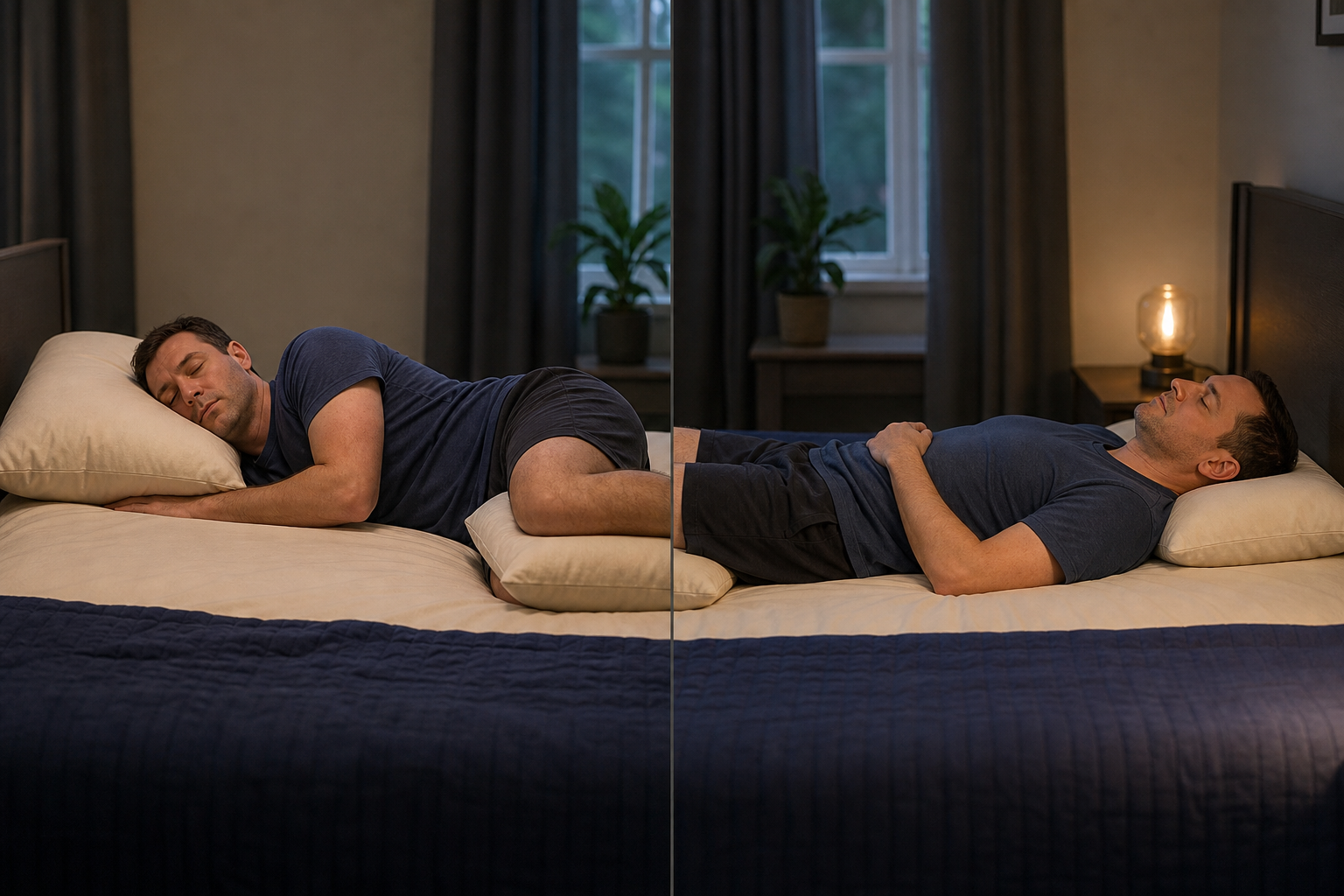
The main difference between side sleeping and back sleeping is the space your pillow must fill. Your shoulder creates a larger gap beneath your head when you lie on your side. On your back, that shoulder gap disappears, so the same pillow can suddenly feel too tall.
Quick answer: Side sleepers commonly need more effective pillow height, while back sleepers commonly need less. Judge the pillow after it compresses, not by how thick it looks on the bed.
Neither position is universally better. The useful question is whether your pillow and optional leg support suit the position you actually use.
Side Sleeping vs Back Sleeping Pillow Height
Pillow height is not just the pillow’s visible thickness. What matters is how high it holds your head once the weight of your head compresses the fill.
For side sleeping, the pillow needs to fill the space between the mattress and the side of your head. If it is too low or collapses too deeply, your head can dip toward the bed. If it is too tall, your head can tilt in the opposite direction.
For back sleeping, the gap is usually smaller. Excessive height can push your head forward and bring your chin noticeably toward your chest. Too little support can leave your head tipped back or your neck feeling unsupported.
This is why a soft, thick pillow can function like a low pillow, while a thinner but firmer pillow can hold you higher.
Check Your Side-Sleeping Setup
Lie in your usual side-sleeping position rather than posing perfectly straight. Keep your shoulder primarily on the mattress unless your pillow’s manufacturer specifically directs otherwise.
Then check three points:
- Head position: Viewed from the front, your head should look comfortably level with the center of your torso rather than tilted toward or away from the mattress.
- Shoulder space: The pillow should fill the space above your shoulder without forcing the shoulder onto the pillow.
- Pillow compression: Notice whether the fill stays under your head or shifts and flattens after several minutes.
Shoulder width affects this gap, but it does not provide a universal pillow measurement. A softer mattress may allow your shoulder and torso to sink farther, reducing the pillow height you need. A firmer surface may leave a larger gap.
You can also try a pillow between your knees or legs. It is optional, but some side sleepers find that it keeps the top leg from dropping forward and makes the position feel less twisted.
Check Your Back-Sleeping Setup
Settle onto your back and let the pillow compress before judging it. Look for a supported position that does not feel forced.
Use these checks:
- Chin angle: If your chin is pushed strongly toward your chest, the pillow may be too tall.
- Head support: If your head falls backward or your neck feels as though it is hovering, you may need a little more effective support.
- Pillow placement: Keep the pillow beneath your head and neck rather than pulling a large portion under your upper back, unless that is the product’s intended design.
A pillow under the knees is another optional adjustment for back sleeping. It can make the position feel more relaxed for some people, but it is not required. Remove it if it creates pressure, feels restrictive, or makes you less comfortable.
If You Switch Between Both Positions
Combination sleepers often need a compromise because one fixed pillow must handle two different gaps. An adjustable-fill pillow or a design with distinct sleeping zones can be useful, but shape alone does not guarantee a good fit.
Do not assume every contour pillow is oriented the same way. Some use different areas for side and back sleeping, while others have specific high-edge or low-edge instructions. Follow the directions for the exact pillow you own.
To compare your setup without changing everything at once:
- Test the pillow on your side for several minutes.
- Check whether your head dips or tilts upward.
- Roll onto your back and let the pillow settle again.
- Check whether your chin is pushed forward.
- Adjust only one variable, such as loft, fill, or placement, before repeating the test.
A mirror or a photo taken from mattress height can make obvious tilting easier to see. Treat this as a comfort check, not a medical assessment.
The Practical Takeaway
Side sleeping usually asks the pillow to fill a larger shoulder-to-head gap. Back sleeping usually calls for a lower effective height. Your body proportions, pillow compression, mattress sink, and preferences determine the final fit.
Stop using a setup that causes new or worsening discomfort. Persistent or severe pain, numbness, weakness, breathing concerns, or ongoing sleep difficulties should be discussed with a qualified healthcare professional.