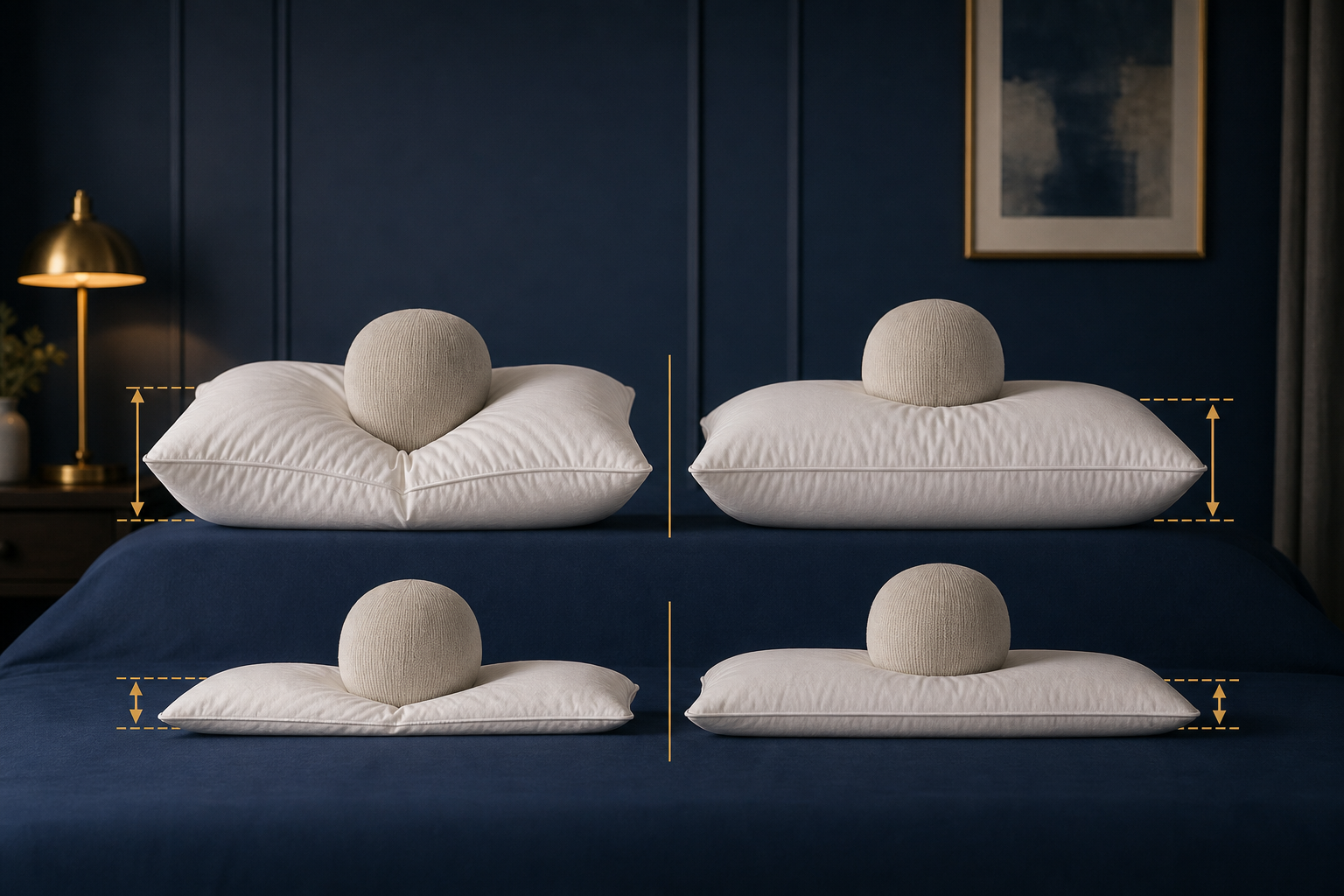
When comparing pillow loft vs firmness, remember that loft is the pillow’s starting height, while firmness describes how strongly it resists pressure. They work together, but they are not interchangeable. A tall, soft pillow can collapse under your head, while a thin, firm pillow can resist sinking without adding much height.
Quick answer: Compare the pillow’s uncompressed height, resistance to pressure, and final height after your head settles into it. That final compressed height often matters more than how tall or firm the pillow seems at first.
What Pillow Loft and Firmness Actually Mean
Loft is the height or thickness of a pillow before you lie on it. Retail descriptions often classify pillows as low, medium, or high loft, although the measurements behind those labels can vary.
Firmness is the pillow’s resistance to compression. A softer pillow yields more readily beneath your head. A firmer one pushes back more and usually retains more of its original shape.
Neither feature tells the complete story. Two pillows with the same advertised loft can hold your head at different heights if one compresses much more than the other. Two firm pillows can also feel different if one has a flat surface and the other has a contour or raised edge.
Pillow Loft vs Firmness in Four Combinations
Thinking in combinations makes pillow descriptions easier to interpret.
| Combination | What you can generally expect | |—|—| | High loft + soft | Starts tall but allows substantial sink | | High loft + firm | Starts tall and retains more height | | Low loft + soft | Stays relatively flat and yields easily | | Low loft + firm | Remains thin but creates stronger resistance |
These are tendencies, not fit recommendations. A high-loft, soft pillow could finish at the same compressed height as a lower, firmer pillow, yet the two would have very different pressure feels.
This is why “supportive” should not be treated as another word for firm. Practical support comes from the pillow maintaining a useful height and shape while still feeling comfortable to you.
Why Compressed Height Matters
The height you experience after settling in can be called the pillow’s compressed height or working height. It is not a standardized specification that every manufacturer provides, so you often need to assess it yourself.
Your working height depends on more than the pillow:
- Sleep position: Side sleeping generally leaves more space between the head and mattress than back or stomach sleeping.
- Body proportions: Shoulder width, head size, and the distance from your shoulder to your neck affect how much space needs filling.
- Mattress sink: If your shoulders settle deeply into a softer mattress, you may need less pillow height. A firmer mattress can leave a larger gap.
- Fill behavior: Solid foam, shredded foam, fiber, feathers, latex, and other fills compress and rebound differently.
- Shape: Gussets, center wells, curves, and raised edges can create several working heights within one pillow.
- Preference: A pillow can hold you at a reasonable height but still feel too hard against your ear, face, or the back of your head.
For a contour pillow, follow that pillow’s current manufacturer instructions for orientation. High and low edges are not intended to be used the same way on every design.
How to Compare Loft and Firmness at Home
A quick squeeze in a store can reveal resistance, but it cannot reproduce your sleeping position or mattress. Use this sequence for a more useful comparison.
- Inspect the starting loft.
Place the pillow on a flat surface without pressing it. Notice its overall height and whether the center, sides, and edges differ.
- Press slowly, not just sharply.
Apply steady pressure with your hand or forearm. Notice how far the pillow compresses, how strongly it pushes back, and whether the fill moves away from the pressure point.
- Test it on your own mattress.
Lie in your usual sleeping position for several minutes. Give the materials time to settle rather than judging the pillow from the first few seconds.
- Check the final position.
Look for a comfortable, neutral-looking head and neck position. When side sleeping, your head should not appear to drop sharply toward the mattress or tilt toward the ceiling. When back sleeping, the pillow should not force your chin noticeably toward your chest.
- Notice what you keep correcting.
Repeated adjustments can reveal the mismatch:
- Folding the pillow suggests you want more working height.
- Pushing fill aside suggests it feels too tall or forceful.
- Bunching fill under your neck suggests the pillow is not maintaining support where you want it.
- Waking to a flattened pillow suggests the starting loft is not surviving compression.
A photo taken from behind can help a side sleeper spot an obvious head tilt. Treat this as a comfort check, not a medical assessment or test of “perfect” alignment.
Choose Height First, Then Refine the Feel
Start by finding a working height that suits your position, proportions, and mattress. Then compare how soft or firm you want the surface to feel at that height.
The best combination is not automatically the tallest, firmest, or softest option. It is the one that retains enough height without creating uncomfortable pressure or requiring constant reshaping. Stop using a setup that causes new or worsening discomfort. Persistent or severe pain, numbness, weakness, breathing concerns, or ongoing sleep difficulty should be discussed with a qualified healthcare professional.