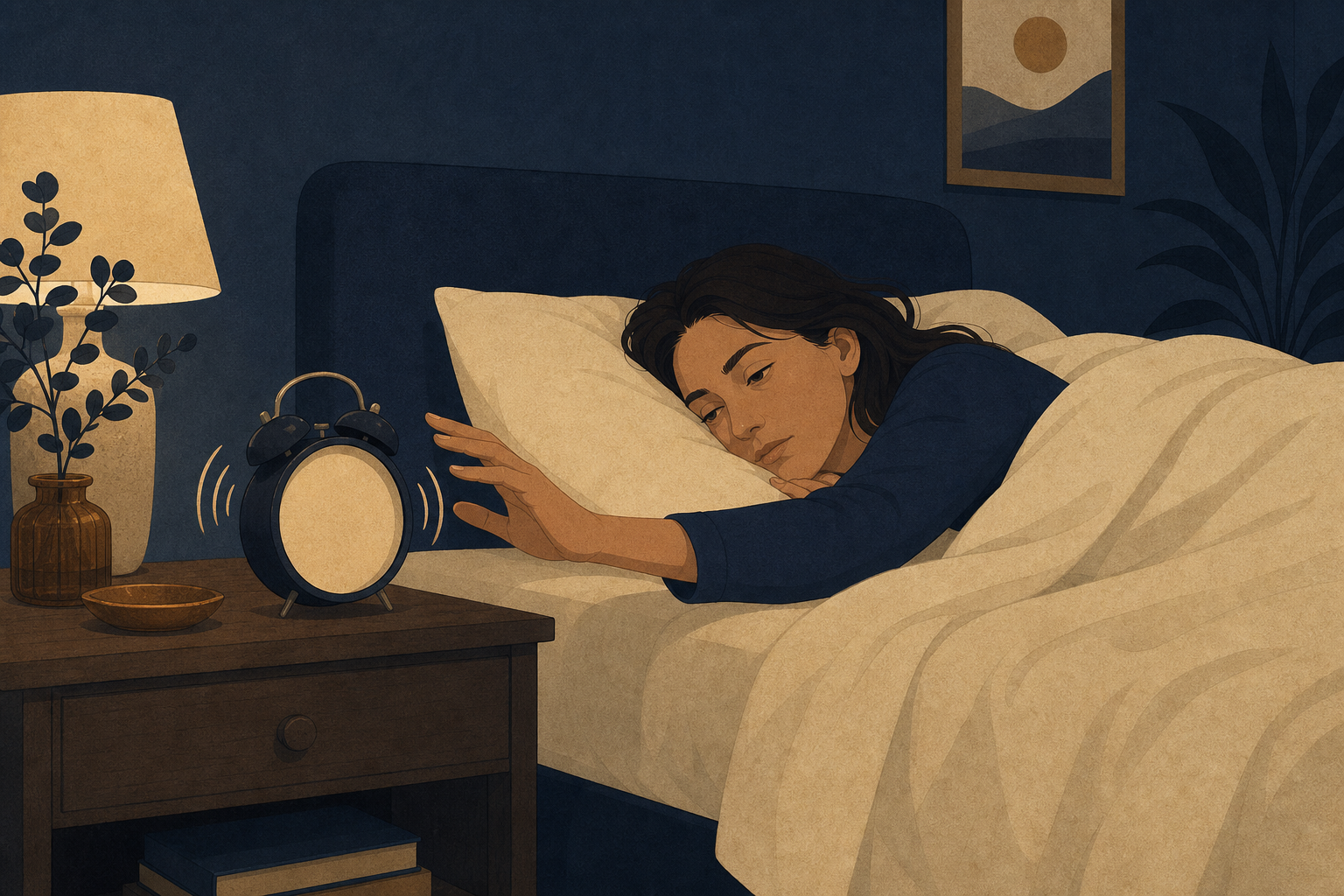
Hitting snooze is not automatically bad for your sleep. Limited research suggests that a brief snooze may not noticeably harm some habitual snoozers and could make the transition out of sleep feel easier. However, repeated alarms interrupt the final part of your sleep, and a long snooze routine can reduce your available sleep time if you set the first alarm earlier than necessary.
The more useful question is whether snoozing helps you get up as planned or hides an ongoing shortage of sleep.
Quick answer: An occasional short snooze is unlikely to ruin an otherwise adequate night of sleep. Repeatedly snoozing for 30 minutes or more, missing obligations, or remaining very sleepy afterward is a reason to examine your sleep schedule and waking routine.
What happens when you hit the snooze button?
After an alarm wakes you, you may experience sleep inertia, the temporary grogginess and slower thinking that can occur during the transition from sleep to alertness. Its intensity varies with sleep loss, time of day, individual sleep patterns, and possibly the stage of sleep from which you awaken.
If you press snooze and fall asleep again, the next alarm interrupts you a second time. Several closely spaced alarms can create a fragmented period containing light sleep, brief awakenings, and repeated attempts to drift off.
That sounds clearly negative, but the research is not that simple.
A small laboratory study of habitual snoozers found that 30 minutes of snoozing caused only a modest reduction in actual sleep and either improved or did not change performance on several cognitive tests immediately after rising. Another small experiment found more light sleep and awakenings during the snooze period, with signs that snoozing could prolong sleep inertia.
These studies used small groups and different methods, so they do not establish one rule for everyone. A much larger app-based study found that snoozing is common and tends to occur more with later bedtimes, but observational data cannot prove that the snooze button itself causes poor sleep.
In short, the relationship between the snooze button and sleep depends partly on how you use it.
When snoozing is more likely to be a problem
A single short snooze and an hour-long chain of alarms are different habits. Snoozing deserves closer attention when it creates one of the following patterns.
You shorten your main sleep period to make room for alarms
Suppose you must leave bed at 7:00 a.m. but set the first alarm for 6:15. If those 45 minutes consist of repeated interruptions, setting one alarm closer to 7:00 could give you a more continuous sleep opportunity.
Snooze time is not necessarily the same as lost sleep because you may fall asleep between alarms. Still, it is generally less continuous than leaving the alarm off until your intended wake time.
Snoozing keeps expanding
A planned 10-minute buffer can become several alarms spread across an hour. If you routinely underestimate how long you will stay in bed, your alarm setup may no longer match your actual morning schedule.
Long snooze sessions can also create time pressure. You may wake feeling rushed because the routine has consumed the time you expected to use for showering, eating, or getting ready.
You are regularly getting too little sleep
Adults commonly need at least seven hours of sleep, although individual needs vary. If you give yourself six hours in bed and rely on repeated alarms every morning, removing the snooze button will not correct the underlying lack of sleep.
Frequent snoozing can be a useful clue: your wake time may be earlier than your current bedtime can support.
You turn alarms off without remembering
An alarm within easy reach can be dismissed while you are still partly asleep. This becomes a practical problem if you oversleep, miss commitments, or need an increasingly elaborate series of alarms to wake up.
Changing the alarm’s location may help, but severe or persistent difficulty waking should not be treated as a simple motivation problem.
When a short snooze may be reasonable
You do not have to eliminate snoozing merely because it is often portrayed as a bad habit. A limited snooze period may be workable if:
- you usually get enough sleep
- you use one additional alarm rather than a long series
- you get out of bed at the planned time
- you do not feel worse after the second alarm
- snoozing does not make you late or rushed
- you are not using it to compensate for an unsustainable bedtime
Some habitual snoozers may find that a short transition feels less abrupt than getting up at the first sound. Current evidence is too limited to promise that this improves alertness, but it also does not support treating every brief snooze as harmful.
The key distinction is whether snoozing is a controlled part of your routine or a daily struggle that keeps growing.
Try a one-week alarm check
Instead of changing everything based on a universal rule, compare two simple routines. Choose a week without unusual travel, illness, or major schedule changes.
- Record your current pattern for three mornings. Note your bedtime, first alarm, final rise time, number of snoozes, and how alert you feel 15 to 30 minutes after getting up.
- Set one alarm for your actual rise time. For the next three or four mornings, remove the early warning alarms. Set the alarm for the latest time that still allows a calm morning.
- Protect the same sleep opportunity. Do not test the single-alarm approach by staying up later. Keep your bedtime reasonably consistent so you are comparing alarm routines rather than different amounts of sleep.
- Make the first minute easier. Put the alarm far enough away that you must sit up or stand to turn it off. Open the curtains, switch on a light, and begin a familiar first task.
- Compare the results. Look at punctuality, morning grogginess, mood, and how rushed you felt. If one alarm leaves you more functional without reducing sleep, it may be the better routine. If one short snooze works well and stays short, there may be little reason to force a change.
This is a practical self-check, not a medical test. Consumer sleep trackers may estimate sleep and wake patterns, but their sleep-stage readings should not be treated as a precise explanation for every difficult morning.
Improve the routine before blaming the alarm
If waking up is consistently difficult, focus first on the conditions surrounding the alarm.
- Allow enough time in bed. Work backward from your required wake time and include the time you normally need to settle down and fall asleep.
- Keep wake times reasonably consistent. Large shifts between workdays and days off can make an early alarm feel harder.
- Use morning light. Opening curtains or moving into a brightly lit room can support the transition into daytime alertness.
- Prepare one immediate action. Drinking water, washing your face, feeding a pet, or starting breakfast gives you a clear step after silencing the alarm.
- Move the phone away from the pillow. This reduces automatic snoozing and keeps late-night scrolling out of easy reach.
- Review evening habits. Late caffeine, alcohol, heavy meals, bright screens, and an irregular bedtime may affect how rested you feel in the morning.
Avoid making the alarm excessively loud if it disturbs other people or causes an unnecessarily stressful awakening. The goal is a reliable cue you can respond to, not the most alarming sound available.
When morning sleepiness needs more attention
Snoozing is sometimes a symptom of a schedule problem, but persistent daytime sleepiness or extreme difficulty waking can have other explanations.
Consider speaking with a qualified healthcare professional if you regularly get adequate sleep opportunity but still:
- struggle to stay awake during work, conversations, or driving
- sleep through multiple loud alarms
- experience ongoing difficulty falling asleep or staying asleep
- wake with breathing concerns or are told that you gasp or stop breathing
- have morning grogginess that remains intense for a prolonged period
- notice that sleepiness is worsening or interfering with daily life
Do not rely on alarm tricks when sleepiness creates a safety risk. If you feel too sleepy to drive or operate equipment safely, stop and address the immediate risk.
The practical takeaway
The snooze button is not automatically bad for your sleep, and current research does not justify a universal ban. A brief, controlled snooze may be neutral or useful for some habitual snoozers.
The habit becomes less helpful when repeated alarms replace continuous sleep, make you late, or disguise an inadequate sleep schedule. Before deleting the snooze function, compare how you feel with one well-timed alarm versus one short snooze. Your best routine is the one that protects enough sleep and helps you get up reliably.