If you are naturally alert late at night but must start work early, build your routine around a consistent wake time rather than trying to force an unrealistically early bedtime overnight. Protect enough hours for sleep, move your schedule earlier in small steps, get light soon after waking, and reduce late-evening signals that keep you alert. The goal is not to become a cheerful morning person. It is to make your early work schedule as a night owl less exhausting and more predictable.
Quick answer: Fix your wake time first, count backward to create a realistic sleep window, and shift bedtime earlier by 15 to 30 minutes every few nights. Use bright mornings, dimmer evenings, an earlier caffeine cutoff, and a repeatable wind-down routine to support the change.
Accept that chronotype is part of the problem
“Night owl” is not simply another term for poor discipline. Chronotype describes your natural tendency to feel sleepy and alert at particular times. Some people become drowsy early, while others do their clearest thinking late in the evening.
An early obligation can conflict with that timing. You may need to get up at 5:30 a.m. even though your body does not feel ready to sleep at 9:30 p.m. Going to bed early does not guarantee that sleep will begin early.
This distinction matters because the answer is not to spend ten frustrated hours in bed. A better plan gradually moves your sleep cues while preserving as much sleep opportunity as your schedule allows.
Most healthy adults need at least seven hours of sleep regularly, although individual needs vary. If your alarm is set for 5:30 a.m., a routine that consistently leaves you awake until midnight is unlikely to provide enough time. No evening ritual can fully compensate for a sleep window that is simply too short.
Build your early work schedule backward
Start with the part of your day that cannot move: the time you must wake up.
Then work backward using the amount of sleep you generally need to feel functional. Add a modest buffer for getting settled and falling asleep. For example:
- Required wake time: 5:45 a.m.
- Desired sleep: 7 hours and 30 minutes
- Time to settle and fall asleep: about 30 minutes
- Target time to get into bed: 9:45 p.m.
Treat this as a planning estimate, not a promise that you will fall asleep on command.
Next, compare that target with your current routine. If you normally get into bed at 12:30 a.m., jumping directly to 9:45 p.m. may leave you wide awake and irritated. Your first target might be 12:00 a.m., followed by 11:30 p.m. after several nights.
A written target is useful because “I should go to bed earlier” is too vague to guide your evening.
Shift the routine in manageable steps
A gradual change is usually more realistic than a dramatic reset. Try moving your bedtime and pre-bed routine earlier by 15 to 30 minutes every two or three nights.
Use this sequence:
- Choose one wake time. Get up at roughly the same time on workdays and days off. If possible, keep weekend variation within about an hour.
- Move the evening anchors. Shift dinner, exercise, showering, and your wind-down period earlier along with bedtime.
- Advance in small stages. Hold each new schedule long enough to see whether you are becoming sleepy earlier.
- Pause when necessary. If you are lying awake for long periods, maintain the current schedule for a few more nights rather than advancing again immediately.
- Review after two weeks. Look at your actual sleep and daytime alertness, not just whether you followed the plan perfectly.
Your wake time is the main anchor, but bedtime should remain responsive to genuine sleepiness. If you get into bed much too early, the bed can become a place for scrolling, worrying, or watching the clock.
Make the morning do some of the work
Light is an important cue for your internal clock. Getting natural light earlier in the day can support an earlier pattern and may make it easier to feel alert after waking.
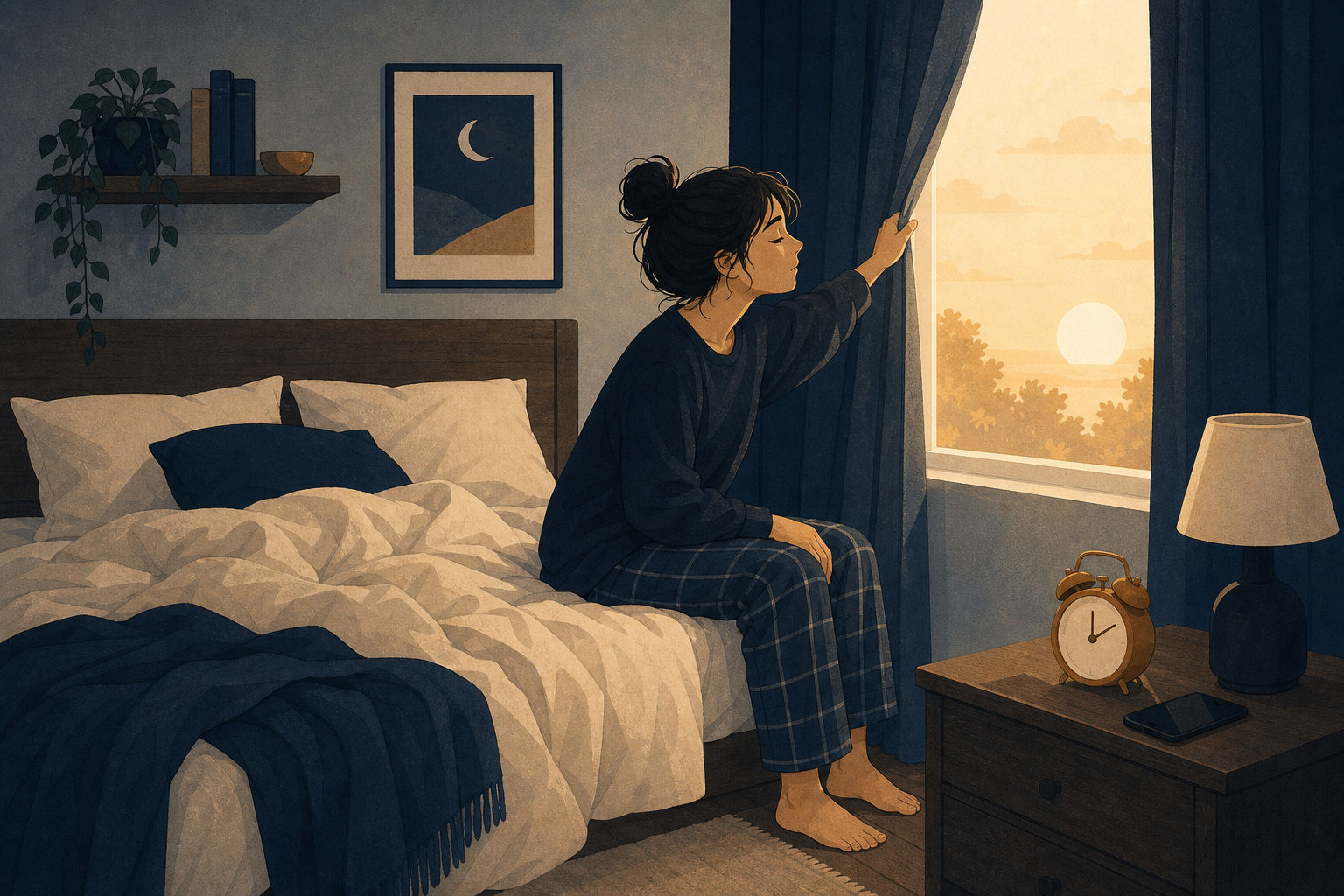
Open the curtains promptly. If conditions and your routine allow, spend some time outside in the morning, such as during a short walk, commute, or breakfast on a porch. Outdoor light is generally much brighter than ordinary indoor lighting, even when the sky is overcast.
Pair morning light with another consistent cue:
- drink water and eat breakfast
- take a shower
- walk for several minutes
- play an energizing playlist
- prepare coffee or tea at the same point in the routine
The specific ritual matters less than its consistency. You are creating a recognizable transition from sleep to daytime rather than negotiating with the snooze button repeatedly.
If you use a specialized bright-light device, ask a qualified healthcare professional about timing and safety, particularly if you have an eye condition, migraines, bipolar disorder, or take medication that increases light sensitivity. Light at the wrong time can shift your schedule in an unhelpful direction.
Reduce the signals that extend your night
You do not need to sit in darkness for three hours before bed. You do need a noticeable contrast between an active evening and your final wind-down period.
About an hour before bed, consider:
- lowering the room lighting
- finishing demanding work
- moving stimulating conversations earlier
- placing your phone out of reach
- choosing quiet reading, stretching, or simple preparation for tomorrow
- keeping the bedroom cool, dark, and quiet
Screens are not the only reason people stay awake. The activity on them also matters. Work messages, competitive games, upsetting news, and endless short videos can keep your attention engaged long after you intended to stop.
Set a clear stopping point instead of relying on willpower while tired. An alarm labeled “start closing the day” may be more useful than a strict “fall asleep now” alarm.
Move caffeine and naps earlier
Caffeine can remain active for hours, so an afternoon drink may still affect bedtime. Choose a cutoff based on your target sleep time and your sensitivity. An eight-hour gap is a practical starting point for someone struggling to become sleepy earlier.
That may mean replacing a 3:00 p.m. coffee with water, a caffeine-free drink, a brief walk, or a snack. Do not use growing amounts of caffeine to cover chronic sleep loss and then expect your body to become sleepy early.
Naps require similar care. If you need one, keep it short and earlier in the afternoon. A long or late nap may reduce the sleep pressure that helps you fall asleep at night. If naps consistently delay bedtime, remove them temporarily while adjusting your schedule.
Plan for evenings that will not cooperate
A realistic routine needs a fallback plan. Some nights will include late events, family demands, deadlines, or an alert second wind.
When bedtime slips:
- keep the next morning’s wake time reasonably close to normal
- get morning light
- avoid turning one late night into an entire late weekend
- use a short, early nap only if needed and safe
- return to the routine that evening without trying to “make yourself” sleep unusually early
Do not drive or perform safety-sensitive work when you are struggling to keep your eyes open, losing focus, or repeatedly yawning. Opening a window or turning up music does not make severe drowsiness safe.
It is also worth examining whether every late-night responsibility is truly fixed. Preparing lunch earlier, simplifying breakfast, sharing household tasks, or shortening a nighttime workout may protect more sleep than another relaxation technique.
Know when the routine is not enough
Being an evening person does not automatically mean you have a sleep disorder. However, consider talking with a qualified healthcare professional if you consistently cannot fall asleep until very late, cannot wake when required, or experience prolonged daytime sleepiness despite allowing enough time for sleep.
Professional guidance is also appropriate if you have ongoing sleep difficulty, loud snoring or breathing concerns, persistent morning headaches, unusual nighttime behaviors, or sleepiness that affects driving or work safety. A sleep diary showing bedtimes, estimated sleep times, wake times, naps, caffeine, and daytime alertness can make that conversation more useful.
Aim for workable, not perfect
Your best routine may not make 5:30 a.m. feel natural. Success can simply mean that you are sleeping earlier than before, waking with less chaos, and obtaining enough sleep more consistently.
Anchor the morning, shift gradually, and make your evenings support the bedtime you actually need. A routine that fits your real obligations and natural tendencies is more useful than an ideal schedule you can maintain for only three days.