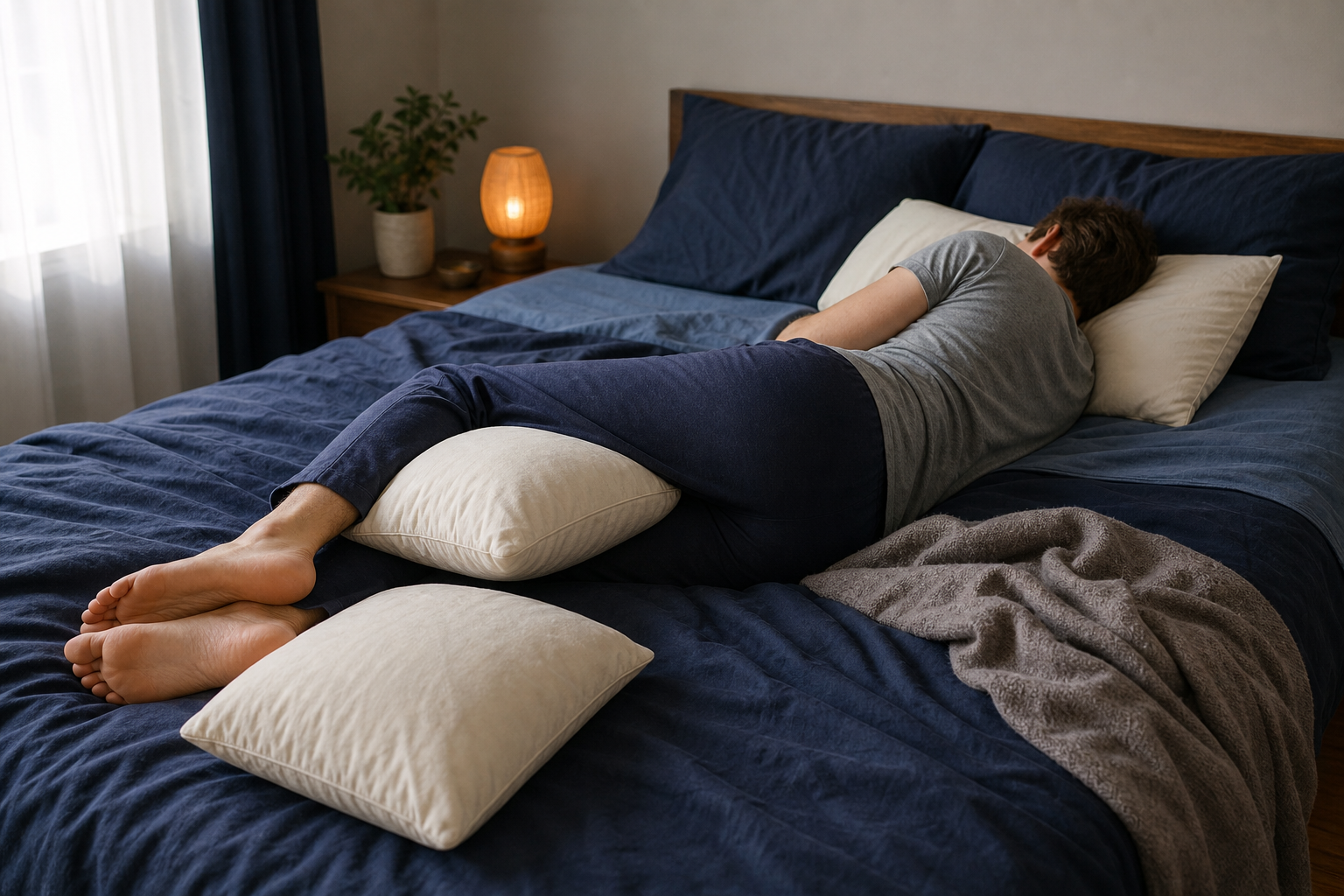
The best sleep positions for back pain are usually back sleeping with support under the knees or side sleeping with a pillow between the knees. Both are relatively easy to adjust without forcing your body into an unfamiliar shape. Stomach sleeping can be comfortable for some people, but it often requires more careful pillow placement.
Quick answer: Start on your back with a pillow under your knees or on your side with one between your knees. Choose the setup that feels supported without creating new pressure, twisting, numbness, or worsening discomfort.
No position is universally best. Your mattress sink, pillow height, body proportions, pain location, and preferred way of sleeping all affect the result.
Comparing sleep positions for back pain
| Position | Potential advantage | Common difficulty | First adjustment to try |
|---|---|---|---|
| Back | Distributes your weight across a broad area | Legs lying flat may feel uncomfortable | Place a pillow under your knees |
| Side | Easy to modify with pillows | Hips and shoulders can rotate or feel pressured | Put a pillow between your knees |
| Stomach | May already be your familiar position | Can increase low-back arching or neck rotation | Support the pelvis and lower abdomen |
These are starting points rather than rules. A position that appears suitable on paper is not useful if it keeps you awake or feels worse after several minutes.
Back sleeping: a balanced starting point
Back sleeping lets your mattress support your torso without concentrating your weight on one hip or shoulder. However, lying with both legs completely straight may feel uncomfortable if it increases the sense of arching through your lower back.
Try this setup:
- Lie on your back with your head on a comfortable pillow.
- Place one pillow under both knees, or use a folded pillow if a full one feels too high.
- Let your legs rest rather than actively holding them together.
- Check whether your lower back feels comfortably supported, not forced flat.
- Reduce or increase the knee support in small amounts.
Your head pillow should fill the space created by your head, neck, and mattress without pushing your chin sharply toward your chest. Pillow compression matters, so judge the height while you are lying down rather than by looking at the uncompressed pillow.
Back sleeping may not suit everyone. If you have breathing concerns, diagnosed sleep apnea, or instructions to avoid this position, follow guidance from your qualified healthcare professional.
Side sleeping: support the space between your legs
Side sleeping is often practical because you can bend your knees slightly and use pillows to limit uncomfortable rotation. The goal is not to curl as tightly as possible. A relaxed bend is generally easier to maintain.
Place a pillow between your knees so the upper leg does not drop heavily toward the mattress. Depending on your proportions, a longer pillow supporting both the knees and ankles may feel steadier.
Check these details:
- Keep your knees gently bent rather than pulled firmly to your chest.
- Avoid twisting your upper body toward the mattress while your hips remain sideways.
- Use a head pillow that fills the shoulder-to-neck space after it compresses.
- If the mattress feels firm at your shoulder or hip, switch sides or reconsider the sleep surface rather than stacking pillows randomly.
- Hugging a pillow can give the upper arm somewhere comfortable to rest.
Broad shoulders, a firmer mattress, and limited mattress sink usually create more space under the head and neck. A softer mattress may let the shoulder sink farther, reducing the pillow height you need.
Stomach sleeping: make smaller adjustments
Stomach sleeping is usually the hardest of the three positions to adapt because the head must turn to one side and the pelvis may sink into the mattress. Still, forcing yourself to abandon a familiar position can make settling down difficult.
If you prefer your stomach, try placing a thin pillow beneath your pelvis and lower abdomen. This may make the position feel less arched through the lower back. Use a thin head pillow if a thicker one angles your head upward, but do not remove head support if doing so feels uncomfortable.
You can also test a partially turned position. Rest closer to your stomach than your side while supporting one bent leg with a pillow. This can reduce how far you need to rotate without requiring a complete change to side sleeping.
Stop if an adjustment causes new neck discomfort, tingling, numbness, or worsening pain.
How to test a position without guessing
A useful test should change one variable at a time. If you replace your mattress topper, head pillow, leg pillow, and position together, you will not know which change helped or caused a problem.
Use this short comparison:
- Choose one position. Start with back or side sleeping unless another position is clearly more comfortable.
- Add one support. Try a pillow under the knees, between the knees, or beneath the pelvis.
- Settle for several minutes. Notice pressure, muscle tension, and whether you keep bracing your body.
- Inspect your head position. It should look and feel comfortably supported rather than sharply tilted, flexed, or extended.
- Check again in the morning. Note new stiffness, disrupted sleep, or supports that moved out of place.
- Adjust gradually. Change pillow thickness, placement, or position before buying something new.
If you use a shaped or contour pillow, follow its current manufacturer instructions for orientation and intended use. High and low edges are not interchangeable across every design.
Position is only part of the setup
A suitable position can still feel uncomfortable on a sleep surface that provides too much or too little sink for you. A soft mattress may allow your pelvis to settle more deeply, while a firm surface may create noticeable pressure at the hips and shoulders.
Before blaming the position, check whether:
- your pillow collapses significantly overnight
- your mattress has a visible or persistent dip
- your leg support is so high that it strains your hips
- your sleepwear or bedding restricts easy movement
- you stay rigidly in one pose instead of changing position naturally
Normal position changes happen during sleep. You do not need to remain perfectly still or recreate an exact pose all night.
A practical takeaway
Begin with two simple trials: back sleeping with knee support and side sleeping with support between the legs. Compare comfort rather than chasing a supposedly perfect position, and keep the setup that lets your body relax without creating new symptoms.
Seek advice from a qualified healthcare professional for severe or persistent pain, pain following an injury, weakness, numbness, spreading symptoms, bladder or bowel changes, breathing concerns, prolonged daytime sleepiness, or ongoing sleep difficulty.