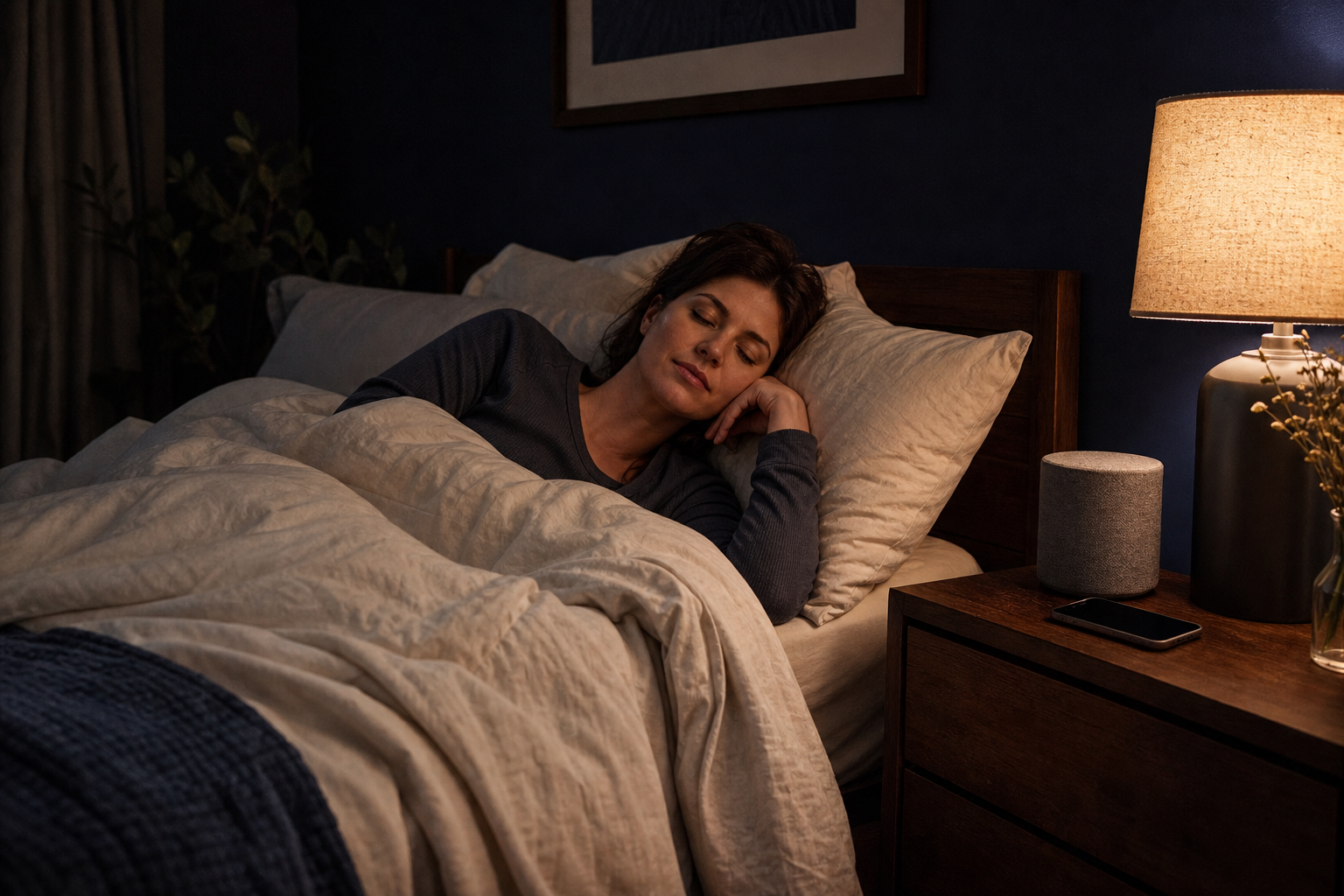
You do not need to sleep in earbuds to experiment with ASMR sleep triggers. Soft voices, tapping, brushing, paper sounds, water, and other predictable recordings can still be enjoyable through a phone, bedside speaker, or smart speaker.
The key is to choose triggers that retain their character without close stereo effects, then keep playback quiet, brief, and physically out of the bed.
Quick answer: Start with a familiar, audio-focused ASMR track played through a nearby speaker at the lowest comfortably audible volume. Set a timer, disable autoplay, and place the device on a stable surface away from pillows and blankets.
Why ASMR can work differently through a speaker
ASMR, or autonomous sensory meridian response, describes the pleasant tingling or deeply calm feeling that some people experience in response to particular sights and sounds. Not everyone experiences tingles, and the triggers people enjoy vary considerably.
Research has documented common triggers including whispering, personal attention, tapping, brushing, water sounds, careful tasks, and slow movements. Personal preference appears to matter, so a popular trigger can be relaxing for one listener and irritating for another.
Speaker playback changes the experience. Earbuds make quiet details and left-to-right movement feel close to your ears. A room speaker blends those effects into the surrounding space. Tracks built around centered voices, consistent volume, and recognizable object sounds usually translate better than recordings that depend on dramatic ear-to-ear movement.
ASMR is not an established treatment for insomnia. An early ASMR survey found that many respondents used it to help them sleep, but that records user behavior rather than proving a reliable sleep benefit. A later systematic review also concluded that more specific and long-term research is needed.
10 ASMR sleep triggers to test without earbuds
Try one or two trigger types at a time. You will learn more from comparing clear categories than from playing a compilation containing every possible sound.
1. Soft speaking and whispering
A steady voice is one of the easiest ASMR triggers to play through an ordinary speaker. Look for slow explanations, quiet storytelling, or softly spoken readings with minimal background music.
Whispering can lose some of its texture at a distance, so clarity matters more than extreme quietness. If you have to raise the volume to understand every word, try a softly spoken track instead. Avoid recordings with sudden laughter, loud introductions, or large volume changes.
2. Personal-attention roleplays
Personal-attention videos imitate calm, focused interactions such as a check-in, fitting, consultation, or simple care routine. Their appeal often comes from patient speech, repeated questions, and deliberate movements rather than the scenario itself.
For audio-only ASMR for sleep, choose a roleplay that explains what is happening aloud. A highly visual performance may become difficult to follow once the screen is off. Preview the premise first so you are not tempted to keep checking the display.
3. Light tapping
Tapping on wood, glass, cardboard, or plastic produces a recognizable rhythm that generally survives speaker playback well. Slow, even tapping tends to blend into a bedroom more easily than fast tapping with sharp peaks.
Material makes a difference. Hollow containers can sound louder and brighter, while books or wooden objects often sound softer. If tapping makes you anticipate the next beat instead of settling down, move on to a less defined sound such as brushing or water.
4. Brushing and hair sounds
Brush bristles, hair brushing, and soft fabric strokes create a continuous texture without requiring you to follow a conversation. They are useful when speech keeps your attention active.
Choose recordings with broad, gentle brushing rather than brushes dragged directly across a sensitive microphone. Close microphone scratching can sound harsh through a small phone speaker. Lowering the volume may help, but switching recordings is usually better than trying to tolerate an unpleasant texture.
5. Paper sounds and page turning
Page turning, book handling, envelope folding, and quiet paper sorting combine soft movement with small crisp details. These sounds can work especially well through a phone speaker because the action remains identifiable even when the finest audio detail is lost.
Listen for controlled handling without tearing, crumpling, or sudden table impacts. A slow reading accompanied by occasional page turns can also be easier to follow than a trigger-only recording.
6. Gentle scratching and textured sounds
Scratching can range from a fingernail moving over fabric to a tool tracing a textured object. The softer end of that range is more suitable for room playback because sharp scratching can become grating on a compact speaker.
Preview this trigger at your intended bedtime volume. If it sounds brittle or makes you tense your jaw, skip it. Irritation is useful feedback, not something you need to overcome to experience ASMR correctly.
7. Water sounds
Pouring, stirring, gentle spraying, and light water movement provide consistent sound without much narrative. They can fill a quiet room while remaining easy to ignore.
Choose recordings with controlled water sounds rather than dramatic splashes. Also check for background hum, loud container knocks, or repeated changes in water pressure. Natural-sounding consistency is usually more bedtime-friendly than a track designed to showcase many different water triggers.
8. Careful repetitive tasks
Sorting cards, folding towels, arranging objects, packing items, or completing a simple craft can create ASMR through repetition and focused attention. These tracks often combine object sounds with quiet narration.
For speaker ASMR for sleep, select tasks with a predictable pace and limited visual information. If the satisfaction comes primarily from watching a perfect arrangement take shape, use it earlier in your wind-down routine and switch to an audio-led track when you turn off the light.
9. Slow hand movements
Hand tracing, pointing, and deliberate gestures are established visual ASMR triggers. They are less suited to completely screen-free listening, but they can still be useful during the first few minutes of a bedtime routine.
Watch at low screen brightness while you are still sitting up, then lock the display when you feel ready to stop watching. If turning off the picture removes everything you enjoy about the trigger, treat it as a pre-bed visual activity rather than an overnight audio track.
10. Subtle mouth sounds
Quiet clicks, lip sounds, and other close vocal noises are intensely preference-dependent. Some listeners find them calming, while others experience an immediate negative reaction.
Start with subtle sounds mixed into soft speech rather than an extended mouth-sound compilation. Speaker playback can make certain frequencies more noticeable, especially on a hard bedside surface. Stop if the sound feels intrusive or unpleasant. Another trigger will be a better fit.
How to play ASMR without headphones
Pick the right speaker option
A phone speaker is the simplest choice for speech, paper sounds, and light tapping. Place the phone on a stable bedside surface, not beside your face or inside the bed.
A compact bedside speaker can reproduce brushing, water, and low-volume details more evenly. Position it far enough away that the sound belongs in the room rather than seeming to come from your pillow.
A smart speaker can reduce screen use if it supports your preferred audio source and voice-controlled timers. Test the commands before bedtime, since services and available controls vary.
Do not sleep on a phone, charger, power adapter, or powered speaker. Apple and Google both warn against keeping connected devices under a pillow, blanket, or body. Use a stable, ventilated surface and follow the device manufacturer’s charging instructions.
Use the lowest comfortable volume
The correct speaker volume is the lowest setting at which the track remains comfortably audible. You should not need to strain, but the recording should not dominate the room.
The World Health Organization notes that both listening volume and duration matter. Its percentage guidance applies to personal audio devices, not every external speaker, so there is no universal bedside-speaker percentage. Adjust according to the device, distance, room, and recording.
A simple self-check is to pause the track. If the room suddenly feels dramatically quieter, reduce the volume and see whether you can still enjoy the trigger.
Set an ASMR sleep timer
A timer prevents a long video, playlist, or stream from continuing after you no longer need it. A practical starting window is 20 to 45 minutes, adjusted to the length of your wind-down routine.
YouTube offers a sleep timer that can pause a video after a selected period. On an iPhone, the Clock timer can use Stop Playing as its end action. Menus and feature availability can change, so confirm the controls on your current app and device.
For other platforms, look for an in-app sleep timer or a supported smart-speaker command. Disable autoplay when possible, and verify that the timer actually stops your chosen audio before relying on it at bedtime.
Make the track predictable
Preview the beginning, middle, and end of a recording. Check for advertisements, music, sudden introductions, louder trigger changes, or an energetic closing message.
Save a small group of familiar tracks so you are not searching in bed. Select one before turning out the light, reduce the display brightness, and lock or turn off the screen once playback begins. This supports a darker bedroom and removes the temptation to keep browsing.
A simple way to find your best trigger
Test triggers at the same quiet volume for several evenings. After each one, ask:
- Did the sound feel pleasant, neutral, or irritating?
- Could I stop following it without effort?
- Did any part make me reach for the volume control?
- Was the recording still enjoyable with the screen off?
- Did the timer leave the room quiet afterward?
Keep the triggers that fade comfortably into the background. Drop anything that makes you more alert, even if it is widely recommended.
ASMR for sleep without headphones is mainly a matter of matching the trigger, recording, speaker, and room to your preferences. Start quietly, use a timer, and let the sound stop rather than running automatically all night. If sleep difficulty remains persistent or significantly affects your days, discuss it with a qualified healthcare professional rather than treating ASMR as a substitute for care.