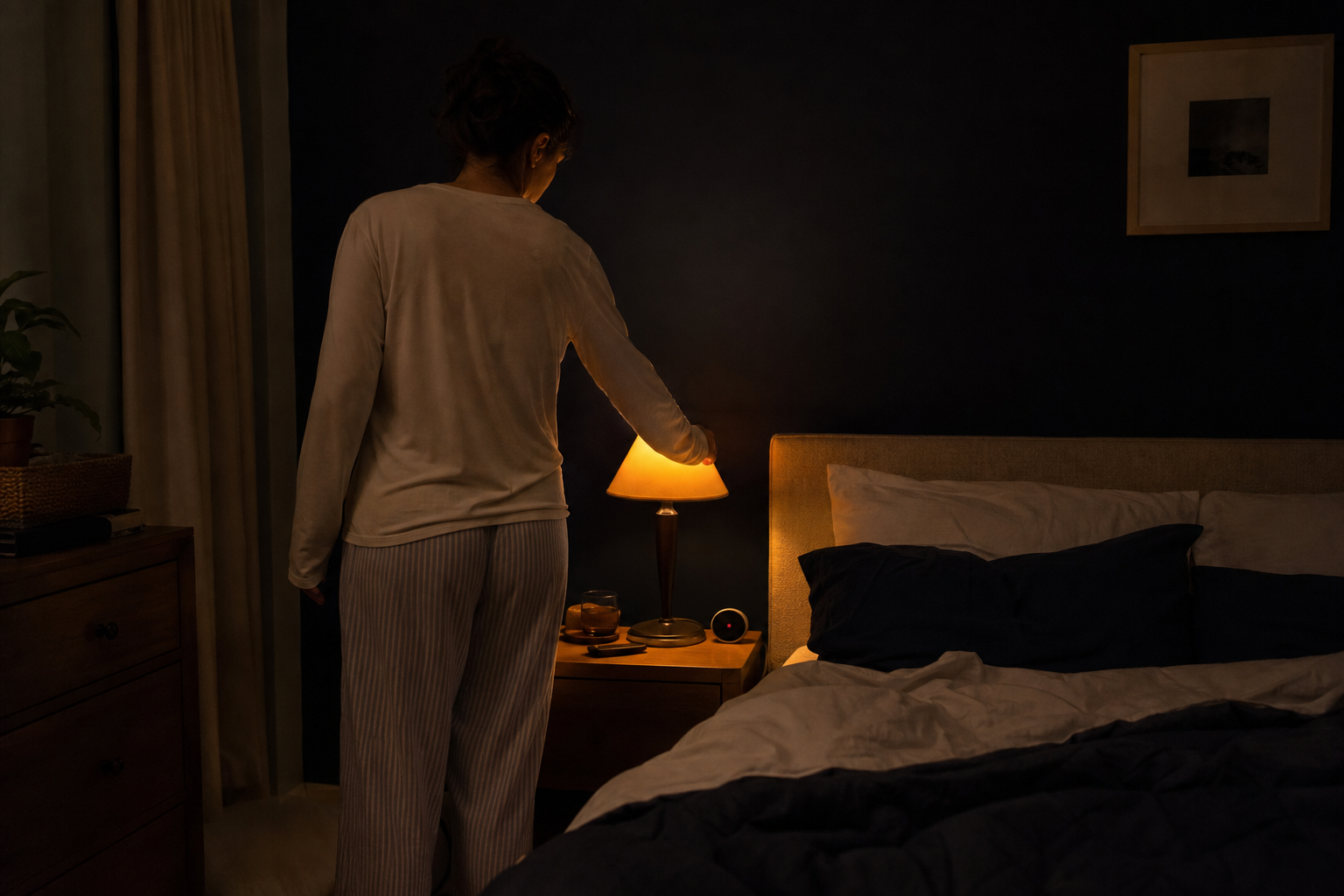
The best LED light color for sleep is no light at all once you are in bed. During the last hour before bed, dim amber is usually the most practical choice for reading and routines, while deep red works well as a minimal orientation light. Whichever color you choose, brightness, placement, and time exposed can matter more than the color name in the bulb’s app.
Quick answer: Use darkness during sleep, dim amber for usable light before bed, and very dim deep red when you need only enough light to navigate. Turn unnecessary lighting off at bedtime.
Best LED Light Color for Sleep: The Practical Ranking
Here is how the main options compare:
| Lighting choice | Best use | Main limitation |
|---|---|---|
| Darkness | Sleeping | Unsafe if you need to navigate obstacles |
| Dim amber | Reading and bedtime routines | Still affects the eyes if it is bright or used for hours |
| Dim deep red | Minimal orientation lighting | Poor color recognition and less comfortable for some people |
| Very dim warm white | Tasks requiring natural-looking colors | Contains a broader range of wavelengths |
| Cool white, blue, or cyan | Daytime visibility | A poor choice close to bedtime |
Current expert recommendations for indoor light exposure favor much lower light in the three hours before bed and an environment that is as dark as practical during sleep.
That does not mean you must spend your evening in total darkness. It means you should use the least light needed for the task, then turn it off when the task is finished.
Why There Is No Magic Sleep Color
The best sleep light is the dimmest option that still lets you do the task safely. Color can matter, but brightness, timing, and whether the light reaches your eyes also shape the setup.
A color label tells you only part of the story. Five variables influence how evening light affects you:
- Spectrum: Which wavelengths the light produces
- Brightness at your eyes: How much light actually reaches your eyes
- Placement: Whether the source points toward your face, book, floor, or wall
- Duration: Whether you see it for five minutes or three hours
- Timing: How close the exposure is to your normal bedtime
The cells involved in regulating circadian timing are particularly responsive to shorter-wavelength light. This is why blue-rich and cool-white lighting is generally less suitable late in the evening.
Scientists can describe the relevant exposure using measurements such as melanopic equivalent daylight illuminance. You do not need to calculate that at home. The practical lesson is that two LEDs that look similarly warm can create different biological signals, and a Kelvin number does not describe the complete spectrum.
A bulb labeled 2200 K or “candlelight,” for example, can be a reasonable starting point. It is not a guarantee that the bulb produces little melanopic stimulation. RGB bulbs, tunable-white bulbs, and dim-to-warm bulbs can create similar-looking colors with different LED combinations.
Most importantly, color does not cancel brightness. A bright red ceiling light can send more total light to your eyes than a tiny amber lamp aimed at a book.
Red vs Amber Light for Sleep
When comparing red vs amber light for sleep, red may have a spectral advantage, but amber often has the practical advantage.
Amber is better for useful evening light
Amber light for sleep preparation is a good compromise when you need to read, fold clothes, prepare for bed, or move around the room. It reduces short-wavelength exposure while providing more useful visual detail than saturated red.
A small household experiment found that a yellow lamp without a blue component did not alter the evening melatonin rise relative to dim light, while several blue-containing lamps did. However, the study included only nine adults and a 30-minute exposure. It does not prove that every amber bulb is harmless.
Use amber when you need functional light for more than a brief moment. Keep it dim and direct it toward the task instead of filling the entire bedroom.
Deep red is useful for orientation
Red light for sleep is often described as if it actively causes sleepiness. The more accurate claim is that deep red generally produces less of the short-wavelength signal associated with alerting and circadian effects.
That makes a very dim red light useful for finding a doorway or navigating a familiar room. Its limited color rendering makes it less suitable for reading labels, choosing clothing, checking medication, or spotting obstacles with similar colors.
Red is also not biologically inert. In one controlled study, six hours of 631 nm red-light exposure near melatonin onset produced a measurable circadian phase delay. That was a long laboratory exposure, not the same as briefly using a dim red night light, but it shows why a bright red room should not be treated as darkness.
There is no strong household trial proving that ordinary red lighting is universally better than dim amber. The practical rule is:
Amber for tasks, red for orientation, darkness for sleep.
Warm white is an acceptable fallback
If you dislike the appearance of red or amber, very warm light before bed can still be reasonable. Choose the warmest available setting, often between approximately 1800 and 2700 K, and dim it as far as the task safely allows.
Warm white is especially useful when accurate color recognition matters. It is not equivalent to darkness, and its appearance alone cannot confirm a low melanopic output.
Why Dimness Can Matter More Than Color
Ordinary room lighting can affect evening physiology even when it does not look extremely bright. In a study of 116 young adults, room light below 200 lux delayed melatonin onset for most participants compared with dim light below 3 lux. That does not mean every household lamp causes poor sleep, but it demonstrates why simply changing a bright bulb from white to red is an incomplete solution.
When setting up dim light before bed, look at what reaches your eyes rather than relying on the bulb’s wattage or app percentage.
A lamp at 10 percent can still be intrusive if:
- the bare bulb is visible from bed
- it sits close to your face
- it lights the entire room
- it reflects from a bright wall or mirror
- it remains on for several hours
A somewhat brighter lamp can sometimes be more practical if it is shaded, positioned below eye level, and aimed only at the page or floor. This placement advice is a practical way to reduce direct exposure, not a claim that floor-level lighting has a special biological effect.
Try this simple check: sit or lie where you normally spend the last part of your evening. If the bulb or individual LED points are directly visible, reposition or shade the source. Then dim it until you can complete the task comfortably without flooding the room.
A Simple Last-Hour Lighting Setup
You do not need specialized lighting equipment. Use your existing bulb, strip, or lamp more deliberately.
- Turn off bright overhead lights. Begin with one smaller lamp instead of illuminating the whole room.
- Choose dim amber for routines or reading. If you only need to navigate, select deep red and keep it very low.
- Aim the light away from your face. Direct a shaded lamp toward your book, nightstand, floor, or wall. Keep decorative LED strips out of your direct line of sight.
- Reduce other bright sources. Lower screen brightness, avoid holding a bright display close to your face, or put devices away when you finish using them.
- Turn unnecessary lights off at bedtime. Use a timer, smart-bulb routine, or simple switch so the presleep light does not remain on after you fall asleep.
The final hour is a useful starting point, but current guidance favors reducing evening light for roughly two to three hours before bed when practical. You can make that gradual: lower overhead lighting earlier, then switch to one small amber lamp during the final hour.
Bright morning and daytime light also helps maintain a clear contrast between day and night. You do not need to keep your entire day dim in an attempt to protect your sleep.
What Is the Best Night Light Color for Sleep?
The best night light color for sleep is very dim deep red or amber, but only when a light genuinely needs to remain on. A dark room is preferable if you can move safely without illumination.
If you need a night light:
- Choose the dimmest setting that still reveals steps and obstacles.
- Place it low and away from the sleeper’s direct view.
- Aim it toward the walking surface rather than the bed.
- Avoid leaving decorative LED strips on around the room.
- Use motion activation if constant lighting is unnecessary.
Safety takes priority over achieving perfect darkness. Older adults, people with limited vision, and anyone at risk of falling should use enough light to move confidently. You also need sufficient illumination to read medication labels or distinguish hazards.
Cover bright indicator lights and block unwanted window light if they remain visible from bed. Small sources can be surprisingly distracting in an otherwise dark room.
Red Bedroom Lighting Is Not Red-Light Therapy
Ambient colored lighting and red-light therapy are different exposures. Therapy studies may use specialized panels, controlled doses, particular wavelengths, or whole-body irradiation.
A small study involving 20 female basketball players has sometimes been used to suggest that red light improves sleep. It involved a specialized intervention in a specific athletic group, not ordinary red bulbs used as bedroom lighting. It cannot establish that leaving red LEDs on treats insomnia or improves sleep for the general population.
Red, amber, and darkness should therefore be compared as environmental lighting choices, not treatments. If you have persistent sleep difficulty, changing a bulb color is not a substitute for guidance from a qualified healthcare professional.
The Bottom Line
Darkness is best while you sleep. For the final hour before bed, choose dim amber when you need usable light and deep red when you need only minimal orientation.
Keep the source shaded, away from your direct gaze, and no brighter than the task requires. A dim, well-placed amber lamp is usually a better bedtime choice than a bright red room.