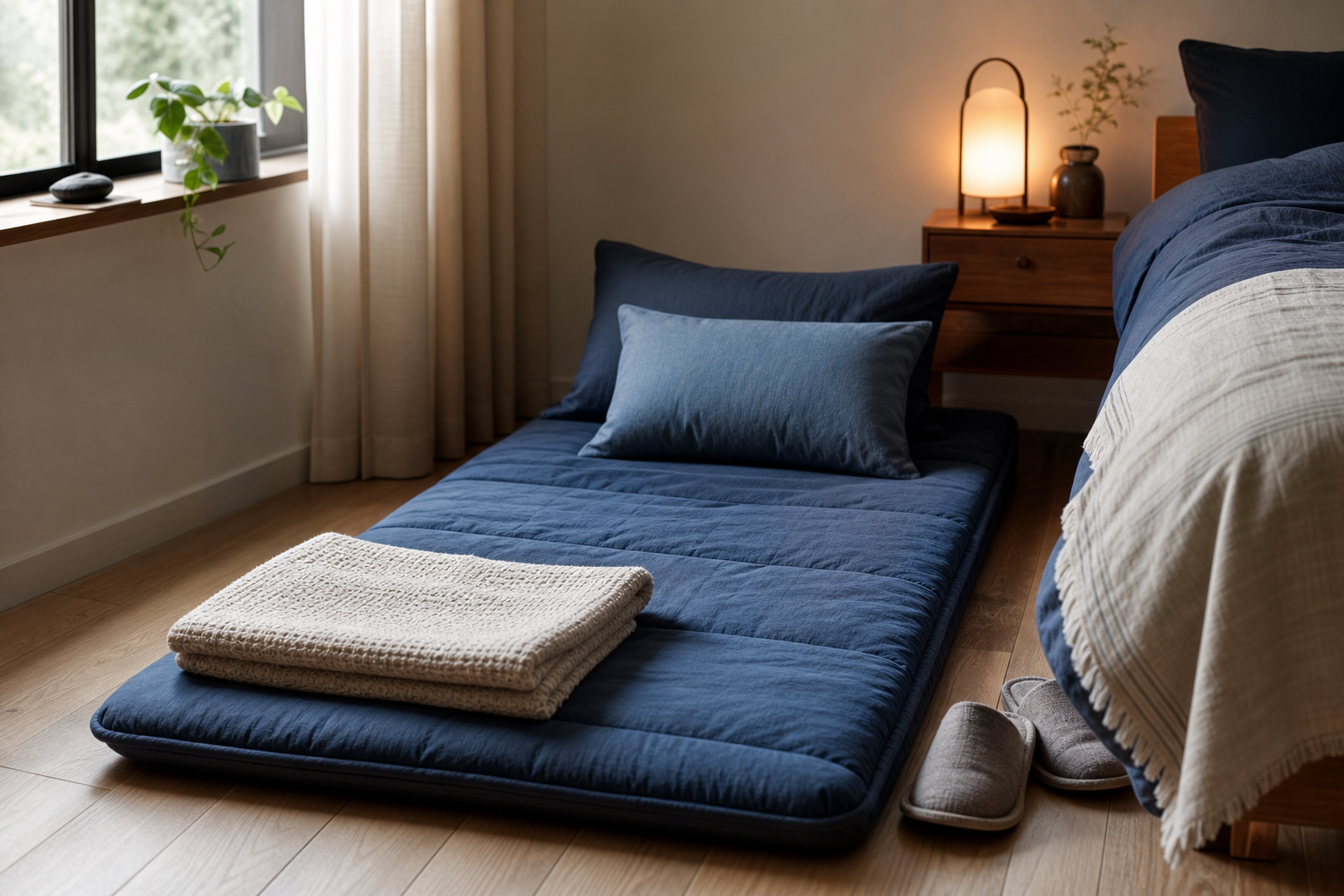
If you want to sleep on the floor, treat it as a controlled comfort experiment, not a test of endurance. A generally healthy, mobile adult can try a clean, padded floor sleeping setup while keeping the regular bed available as a backup.
You do not need to lie directly on hardwood, tile, or carpet. The important checks are whether you can get up safely, have enough cushioning, stay comfortably warm, keep the bedding dry, and stop promptly if the setup causes problems.
Quick answer: Sleeping on the floor is not proven to be healthier than sleeping on a mattress. Seven nights can be a useful observation window, but it is optional. Use padding, change one setup variable at a time, and stop whenever safety, comfort, or sleep quality gets worse.
Research directly comparing floor sleeping with conventional beds is limited. Mattress studies also do not support the idea that the hardest possible surface is universally best. In fact, research comparing mattress firmness has often produced better overall results for medium-firm surfaces than very firm ones.
That does not tell us which floor setup will suit you. It does tell us that bare-floor hardness should not be the goal.
1. Decide what your floor sleeping trial will test
Begin with one specific question. Otherwise, you may finish the week knowing only that the experience felt different.
Your question could be:
- Does a firmer temporary surface feel comfortable enough for a full night?
- Could roll-up bedding work in a small room?
- Does a low setup make you uncomfortably cold?
- Can you change positions and get up without difficulty?
Before changing surfaces, record two or three normal nights in your usual bed. Note roughly how long you took to settle, how often you remember waking, your morning comfort, and whether you slept your usual number of hours.
This is not a clinical test. It simply gives you a fairer comparison than relying on your memory of an average night.
2. Confirm that you can get down and up safely
Test the floor transfer while fully awake. Lower yourself without dropping suddenly, pause on the floor, and stand again without rushing. Consider whether you could repeat the movement in the dark when tired or needing the bathroom.
A stable chair nearby can provide a planned handhold, but do not rely on a lightweight table, rolling chair, or other object that could move. Keep a phone, lamp, glasses, mobility aid, and anything else you need within reach.
Do not conduct the trial alone if you cannot complete the transfer safely. Reduced mobility, significant balance problems, reduced sensation, fragile skin, or difficulty repositioning independently also change the risk calculation. Ask an appropriate healthcare professional for guidance before using a hard, low sleep surface.
3. Prepare a clean, flat, hazard-free area
Choose the location before spreading out bedding. Vacuum or clean the floor, then inspect it at floor level rather than assuming an open-looking space is clear.
Check for:
- cords crossing the route to the door or bathroom
- uneven boards, sharp transitions, or damaged flooring
- damp carpet or signs of moisture
- floor vents that the bedding could block
- sharp furniture corners close to your head
- doors that could swing into the sleeping area
- small objects that could press through thin padding
- space needed by another person or pet walking at night
Your bedding should not create a new trip hazard. Leave a clear route wide enough for you to stand, orient yourself, and walk without stepping over loose blankets.
4. Use enough padding for your pressure points
Learning how to sleep on the floor does not mean learning to tolerate a bare surface. Start with clean, dry padding such as folded blankets, a sleeping mat, a thin topper, a futon-style pad, or another floor-appropriate sleep mat.
Lie in your normal position for at least 15 minutes. Pay attention to your shoulders, ribs, hips, tailbone, knees, and heels. Add or rearrange padding if you notice sharp pressure, growing tenderness, or an immediate need to escape the position.
Too little padding can make pressure the dominant sensation. Very thick padding may feel similar to an ordinary mattress, but that is not a failure if it produces the usable setup you need. There is no universal thickness that everyone must follow.
The practical target is a surface that feels firm enough for your intended experiment without creating concentrated pressure.
5. Check moisture, airflow, and mattress instructions
Bedding placed directly over a cool floor can trap moisture underneath. Each morning, lift, fold, or roll the layers so both the bedding and floor can air. Inspect the underside for dampness, discoloration, condensation, or a musty odor.
Do not cover questionable moisture with another blanket and continue. Dry the area and identify the cause first.
If you plan to put a mattress on the floor
Check the current care, support, and warranty instructions from that mattress’s manufacturer. Some mattresses are not intended for direct floor placement, and using an unapproved support surface can affect airflow, performance, or warranty coverage.
Do not assume that advice for one mattress brand applies to another. A full mattress can also be cumbersome to lift and air each day, which makes moisture checks harder than with roll-up bedding.
6. Plan for floor temperature and drafts
The temperature close to the floor can differ from the temperature at bed height. Tile, concrete, exterior walls, windows, and air-conditioning drafts can make a low setup feel colder than expected.
Use adjustable layers both under and over your body. A layer underneath can reduce heat loss into the floor, while removable blankets let you respond to changes during the night.
A cool bedroom can be comfortable, but colder is not automatically better. If you are waking because your shoulders, feet, or the side against the floor feels cold, change the insulation or return to your bed.
7. Rebuild the setup for your sleep position
Your sleep posture is one comfort variable, not a reason to force a position that feels wrong. Recreate the pillow and leg support you normally use, then change only the floor surface so you can tell which part affects comfort.
Changing the surface changes how far your body sinks. That can alter both pressure and the pillow height that feels comfortable.
Judge your pillow only after assembling the complete floor sleeping setup. Aim for a head and neck position that looks neutral and feels relaxed, without treating a photograph or mirror check as a medical assessment.
Sleeping on the floor as a side sleeper: Side sleepers commonly need more cushioning around the shoulder and hip. Because the shoulder may sink less than it does on a mattress, your usual pillow could feel too low or too high. Adjust the pillow and padding separately. You can also test a pillow between your knees if it improves comfort.
Sleeping on the floor as a back sleeper: Check whether your head pillow pushes your head noticeably forward on the firmer surface. A thinner pillow may feel better, but there is no required height. You can try a small cushion under your knees and keep it only if it makes the position more comfortable.
Stomach sleeper: A thick head pillow may feel awkward when your torso sinks less. Trying a thinner pillow or no head pillow is reasonable if you remain comfortable. Do not force either option.
Combination sleeper: Make sure the pad is wide enough for rolling over without landing partly on the bare floor. Test whether blankets bunch up or restrict movement.
Body proportions, shoulder width, pillow compression, sleep position, and surface sink all affect fit. A pillow that works well on your regular mattress is not guaranteed to fit the floor setup unchanged.
8. Change one variable at a time
Start with 15 to 30 minutes on the completed setup while awake. A short nap can be another test if naps do not interfere with your nighttime sleep.
If the setup remains comfortable and you can get up easily, try one night. Keep the regular bed ready so you can move without treating that decision as a failed experiment.
During the seven-night window, change only one main element at a time, such as:
- padding thickness
- pillow height
- insulation beneath the pad
- knee or leg support
- bedding used for warmth
Record a short scorecard each morning:
- approximate time needed to settle
- remembered awakenings
- whether you slept roughly your normal hours
- temperature comfort
- ease of turning over
- ease of getting up
- neck, shoulder, back, hip, and pressure-point comfort
- numbness, tingling, skin tenderness, or allergy symptoms
- dampness or odor under the bedding
This makes it easier to separate a padding problem from a pillow, temperature, or room problem.
9. Write your stop rules before night one
Seven nights is a maximum observation window, not a challenge you have to complete. End the floor sleeping trial and return to your regular bed for:
- new or clearly worsening pain
- persistent pressure tenderness or skin redness
- numbness, tingling, weakness, or pain spreading into a limb
- difficulty turning over or getting up safely
- dizziness or unsteadiness during transfers
- repeated sleep loss that affects safe daytime functioning
- coughing, wheezing, congestion, or another reaction to dust or dampness
- wet bedding, condensation, visible mold, or a musty smell
Do not interpret worsening symptoms as proof that your body is adapting. A trial can reasonably end after 20 minutes or on the first night.
Severe or persistent pain, breathing concerns, new weakness or numbness, bladder or bowel changes, fever, symptoms after a fall or injury, or other concerning changes deserve appropriate medical attention rather than another adjustment to the sleep surface.
The decision after seven nights
Compare your notes with your baseline. Continue using the setup only if it stays safe, clean, dry, and at least as comfortable and restful as your realistic alternative.
A week cannot prove that sleeping on the floor is healthier or establish a long-term medical benefit. It can tell you whether this particular combination of room, padding, temperature, pillow, and sleep position works well enough for you.