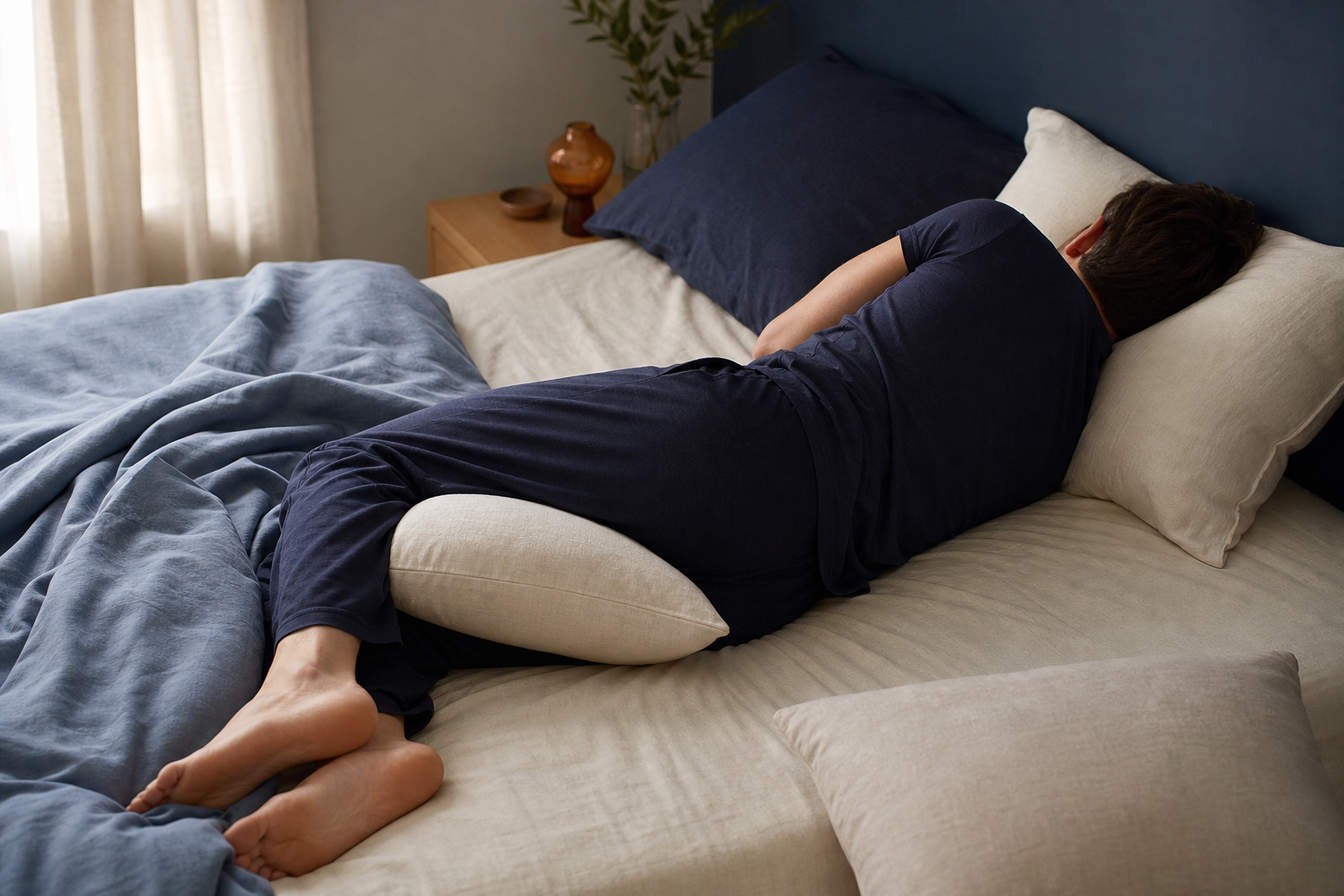
The best sleeping posture for back pain is usually the position that feels comfortable while keeping your body in a relaxed, neutral-looking line. Side sleeping with a pillow between the knees and back sleeping with support under the knees are sensible starting points. Neither is universally best. Your pain pattern, body proportions, pillow compression, and mattress sink can change which setup feels supportive.
Quick answer: Start on your side with a pillow between your knees or on your back with a pillow beneath them. Adjust the support until your shoulders, hips, and legs feel relaxed rather than twisted or strained.
Choosing a sleeping posture for back pain
A sleep position should not be judged by its name alone. Two people can both sleep on their sides while using very different pillow heights, leg positions, and mattress surfaces.
Focus on what happens after you settle into bed:
- Does your torso feel twisted?
- Is your waist hanging without support?
- Are your hips sinking much farther than your shoulders?
- Does your head tilt sharply toward or away from the mattress?
- Does the position create new or worsening discomfort?
You do not need to hold a rigid, picture-perfect posture. The practical goal is a position you can maintain without obvious bending, rotation, or muscle tension.
Side sleeping: support between the knees
Side sleeping is a useful first option because the leg position can be adjusted easily. Bend your knees slightly rather than pulling them tightly toward your chest. Place a pillow between your knees so the upper leg does not drop forward and rotate your hips.
Try this setup:
- Lie on the side that feels more comfortable.
- Bend both knees gently.
- Place a pillow between your knees and, if needed, your lower legs.
- Adjust your head pillow so your neck looks level rather than angled sharply.
- Notice whether your waist feels supported or suspended above the mattress.
A pillow placed between only the knees may slip or allow the ankle to drop. A longer pillow that supports more of the upper leg can feel steadier, but it is optional.
Your head pillow also matters. Side sleepers usually need enough height to fill the space created by the shoulder. The required height depends on shoulder width, pillow compression, and how deeply the shoulder sinks into the mattress.
Back sleeping: place support beneath the knees
Back sleeping distributes contact across a broad area, but straight legs can feel uncomfortable for some people. A pillow under the knees can create a small bend in the legs and reduce the sense of pulling through the front of the hips or lower back.
Lie on your back and place one or two pillows beneath your knees. Use only enough height to feel relaxed. Excessive elevation can make the position feel cramped.
Check your head pillow at the same time. A pillow that is too tall may push your head forward, while one that is too low may feel unsupported. Look for a comfortable position in which your face points generally toward the ceiling and your chin is not forced tightly toward your chest.
A small rolled towel near the waist may feel supportive to some sleepers, but it should not create a hard pressure point or force the back into a pronounced curve.
If you prefer sleeping on your stomach
Stomach sleeping often requires more head rotation and can exaggerate the space beneath the waist, especially on a firm mattress. If it is the only position in which you can settle comfortably, you do not have to force an immediate change.
Experiment with a thin pillow beneath the lower abdomen or hips. You may also prefer a thinner head pillow, although the appropriate height depends on your mattress and body proportions.
Stop if an adjustment increases discomfort. A gradual move toward a partial side position, supported by a pillow along the body, may be easier than trying to change your usual posture in one night.
Account for mattress sink and pillow construction
The same posture can feel completely different on another bed. A softer mattress may let the hips and shoulders sink deeply, while a firmer surface may leave gaps beneath the waist or knees.
Pillows also lose height when compressed. Judge them while lying down, not by how thick they look on the bed.
For shaped or contour pillows, follow the current manufacturer’s orientation and use instructions. Do not assume every contoured design places its higher or lower edge in the same direction.
Run a simple three-night comfort check
Change one part of your setup at a time. For example, test knee support before replacing your head pillow.
Each morning, note:
- the position in which you woke
- whether discomfort was better, unchanged, or worse
- any new pressure, tingling, or stiffness
- whether pillows stayed in place
- how easy it was to change position
Minor adjustments may be more informative than forcing one supposedly ideal posture.
Persistent or severe pain, pain following an injury, weakness, numbness, loss of bladder or bowel control, fever, unexplained weight loss, breathing concerns, or prolonged sleep difficulty should be discussed with an appropriate qualified healthcare professional. Sleep-position changes are comfort experiments, not a substitute for evaluation.
The best final setup is the one that remains comfortable on your actual mattress, with your pillows compressed beneath you, and does not create new symptoms.