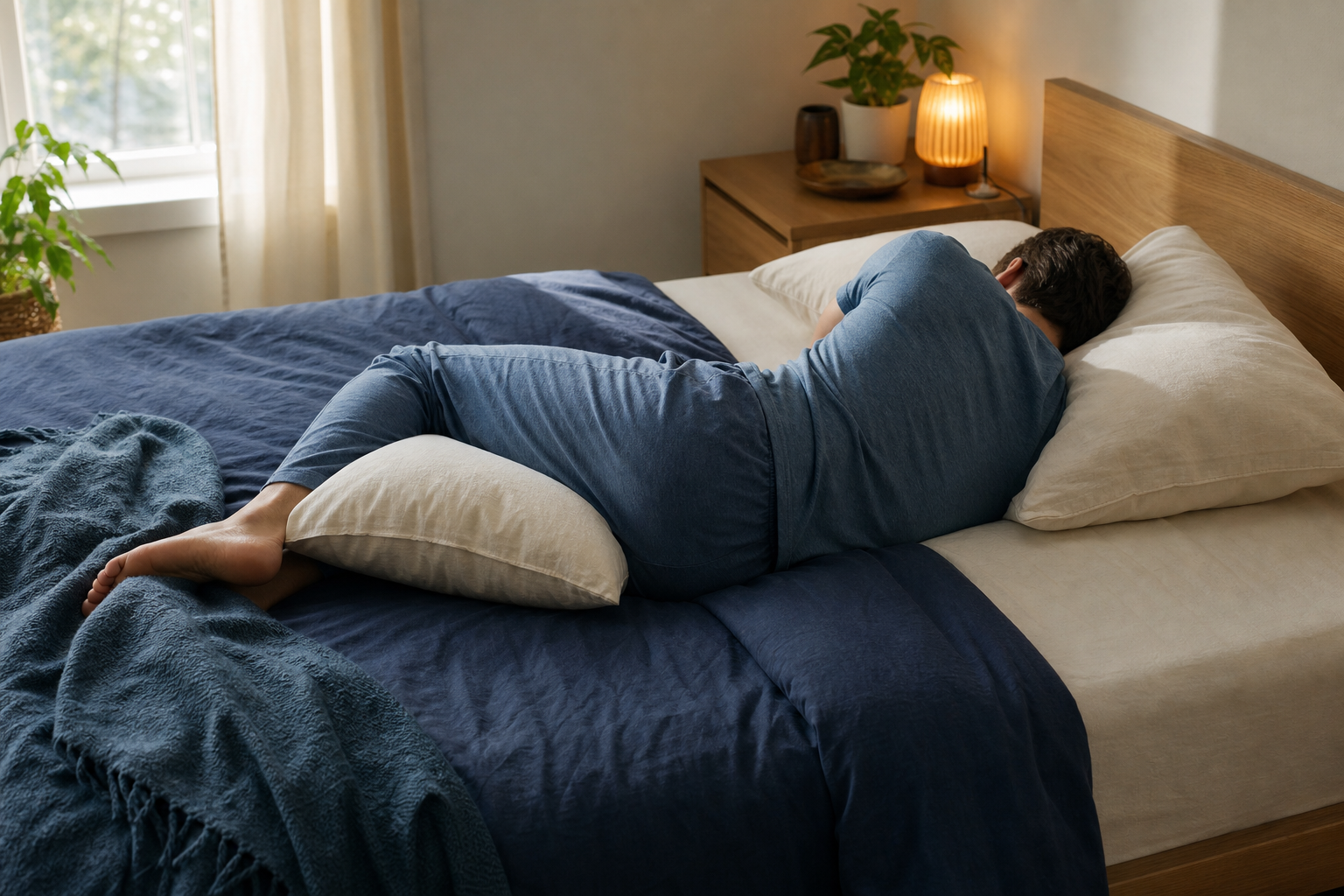
There is no single healthiest sleeping position for every adult. Side sleeping is often a practical starting point, back sleeping can feel well supported with the right setup, and stomach sleeping tends to require the most head and neck rotation. Your best position is one that feels comfortable, allows easy breathing, and does not create new or worsening discomfort.
Quick answer: Compare side and back sleeping first, then adjust your pillow and leg support. Health needs, pregnancy, mattress sink, and personal comfort can change which position suits you.
Comparing the main healthy sleep positions
Each position has tradeoffs. How those tradeoffs feel depends partly on your shoulder width, body proportions, mobility, pillow compression, and how deeply you sink into the mattress.
Side sleeping
Side sleeping is a versatile option because it can accommodate different pillow heights and may be preferable in certain situations involving breathing, pregnancy, or reflux. It is not automatically comfortable, however.
A pillow that is too low can let your head dip toward the mattress. One that is too high can push it in the opposite direction. Your mattress also matters: if your shoulder sinks deeply, you may need less pillow height than you would on a firmer surface.
Try these adjustments:
- Use enough pillow height to fill the space between your head and mattress without sharply tilting your head.
- Let your shoulders rest on the mattress rather than crowding them onto the pillow.
- Place a pillow between your knees if it makes your hips and legs feel more settled.
- Switch sides if one shoulder, hip, or ear becomes uncomfortable.
Left-side sleeping is sometimes suggested for nighttime reflux, but position is only one consideration. Meal timing and clinician-recommended strategies may also matter. During later pregnancy, side sleeping is generally recommended, with either side potentially used unless a maternity professional gives different guidance.
Back sleeping
Back sleeping distributes contact across the back of the body and avoids the sustained head rotation required by stomach sleeping. It can be comfortable when your pillow supports your head without pushing it too far forward.
If your lower back feels tense or unsupported, placing a small pillow beneath your knees may make the position feel more relaxed. The amount of support needed varies with the natural shape of your body and the firmness of your mattress.
Back sleeping is not the best default for everyone. It can allow the tongue and soft tissues to shift backward, which may worsen snoring or obstructive breathing in some people. Anyone with suspected sleep apnea, gasping, witnessed breathing pauses, or substantial daytime sleepiness should seek professional assessment rather than relying on a position change.
Stomach sleeping
Stomach sleeping usually requires turning your head to one side for long periods. A thick pillow may also lift the head farther from the mattress, while a very soft mattress can let the midsection sink considerably.
If stomach sleeping remains your clear preference, experiment cautiously:
- Try a thinner head pillow if that feels comfortable.
- Avoid forcing your head to its maximum turning range.
- Consider a small, thin cushion beneath the hips only if it makes the setup feel more even.
- Alternate the direction your head faces when practical.
Stop an adjustment if it creates new discomfort. You do not have to force yourself into another position overnight, but you can gradually begin on your side or back and see whether it feels sustainable.
How to find healthy sleep positions for your body
Use comfort and a neutral-looking head position as practical checks, not as a diagnosis of alignment.
- Start in your preferred position. Notice whether you can settle without bracing your shoulders, jaw, back, or hips.
- Check your head angle. From the side, your head should not appear dramatically tipped toward or away from the mattress.
- Notice pressure points. Persistent pressure at the shoulder, hip, ear, knees, or lower back suggests that the position or sleep surface needs adjustment.
- Change one variable. Test pillow height, knee support, or position separately so you can tell what made a difference.
- Review the result in the morning. Mild adjustment can feel unfamiliar, but new or worsening discomfort is a reason to stop.
You will naturally move during sleep, so the goal is not to hold one pose perfectly all night.
Match your pillow to the position
Side sleepers often need more space filled between the head and mattress than back sleepers, while stomach sleepers commonly prefer less height. These are starting points, not fixed rules.
Pillow loft changes under your head, and mattress sink changes the distance the pillow must fill. Contoured pillows also vary in shape and intended orientation. Follow the current manufacturer’s instructions for a specific pillow rather than assuming every raised or lowered edge should face the same way.
When position advice needs extra care
Consult a qualified healthcare professional about persistent or severe pain, weakness, numbness, breathing concerns, prolonged daytime sleepiness, or ongoing difficulty sleeping. Position experiments should support comfort, not replace an appropriate evaluation.
For most adults, the sensible next step is simple: compare side and back sleeping, make one small support adjustment, and keep the setup that feels comfortable without creating new problems.