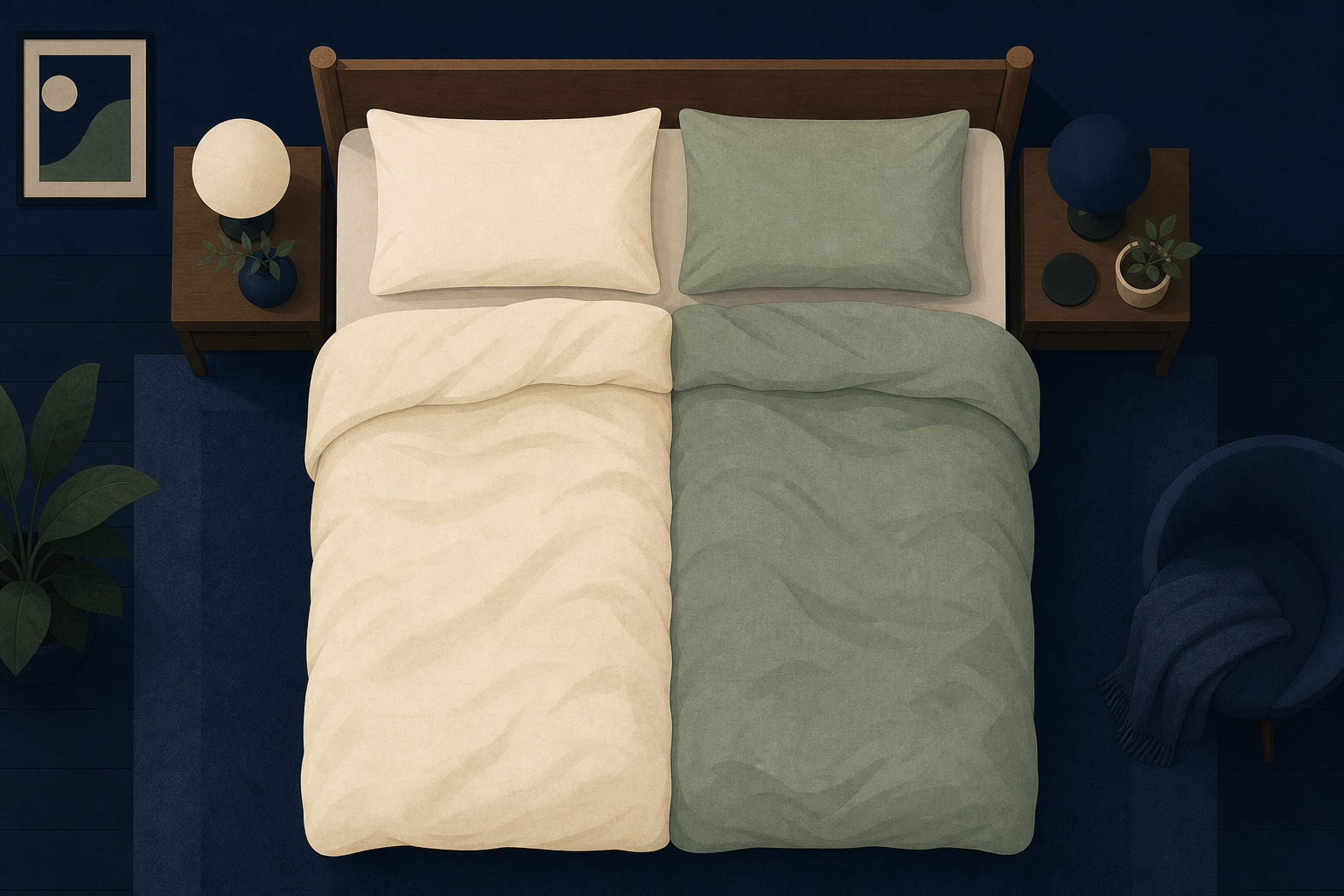
The Scandinavian sleep method is a shared-bed setup in which each person uses a separate duvet instead of both people sleeping under one large cover. It can reduce blanket pulling and let each sleeper choose a different level of warmth without requiring separate beds.
You do not need a Scandinavian-style bedroom, a new mattress, or matching sleep preferences to try it. You simply need two covers that give each person enough room to turn over comfortably.
Quick answer: Replace the shared duvet or comforter with two individual covers, one for each side of the bed. Test the arrangement with blankets you already own before buying new bedding.
What the Scandinavian sleep method changes
With a conventional setup, two people share the same top sheet, blanket, or comforter. Every movement affects the shared covering. If one person rolls over, pulls the duvet upward, or throws it off, the other person may feel the result.
The two-duvet method separates that part of the sleep environment. You still share the mattress, bed frame, and bedroom, but each sleeper controls their own cover.
That means you can:
- Pull the duvet around your shoulders without uncovering your partner
- Turn over without twisting a shared top layer
- Use a lighter or warmer cover than the person beside you
- Uncover your feet or legs without changing your partner’s bedding
- Wash or replace one duvet without changing the other
This is a bedding arrangement, not a sleeping position for couples. You can sleep on your side, back, stomach, or change positions during the night. The method also does not require you to sleep farther apart.
How to try two duvets on one bed
You can test the idea in one night without replacing your entire bedding set.
1. Start with two blankets you already have
Before buying two duvet inserts and covers, place a separate blanket on each side of the bed. Choose blankets that are large enough to cover one person from shoulders to feet with some extra width for turning.
Use this temporary setup for several nights. One night may not tell you much, especially if the weather, room temperature, or your normal bedtime routine changes.
During the test, notice:
- Whether either cover feels too narrow
- Whether the blankets bunch between you
- Whether one slides off the outer edge
- Whether you miss having a shared top sheet
- Whether pulling and uncovering happen less often
- Whether each person can adjust their warmth more easily
If the test feels cramped, the concept may still work with wider covers. It does not automatically mean separate bedding is a poor fit.
2. Choose each duvet independently
The two duvets do not need identical warmth, weight, fill, or construction. Personal choice is one of the main practical reasons to use this setup.
A person who tends to feel warm may prefer a lighter insert. Someone who often feels cold may want a warmer one. Seasonal changes may also mean switching one duvet while leaving the other unchanged.
Consider each sleeper’s preferences for:
- Warmth
- Weight over the body
- Loft or puffiness
- Fabric feel
- Ease of washing
- Sensitivity to particular fill materials
Follow the current manufacturer’s instructions for an individual duvet’s intended use, cleaning, drying, and cover size. Warmth labels and dimensions are not perfectly consistent across brands, so compare actual measurements rather than relying only on names such as twin or single.
3. Check the width before committing
Each duvet needs enough width to cover one sleeper while they change positions. A cover that only reaches from the center of the body to the outer edge of the mattress is likely to feel restrictive.
Lie down and pull the proposed cover over yourself. Roll onto each side and bend your knees as you normally would. The edges should remain around you without requiring precise placement.
Also inspect the center of the bed. A little overlap between the two covers can close the gap without turning them back into one shared layer.
Bed size matters, but body size and sleep movement matter too. Two compact single duvets may fit neatly on a large bed, while active sleepers may prefer wider individual covers. Measure the mattress and proposed duvets instead of assuming one standard combination works for every couple.
4. Decide what to do with the top sheet
A shared flat sheet can reintroduce some of the pulling that separate duvets are meant to avoid. For that reason, some people use a fitted sheet on the mattress and sleep directly under their individual duvet covers.
However, skipping the top sheet is optional.
You can keep one if both sleepers like it, try two individual top sheets, or remove it during the test. If the duvet cover becomes the layer next to your body, wash it according to its care instructions and your normal bedding routine.
The useful question is not whether your bed looks traditionally Scandinavian. It is whether each layer makes the setup more comfortable or creates another shared point of tension.
5. Make the bed in a way you can repeat
Two duvets will not look exactly like one uninterrupted comforter, but the bed can still appear orderly.
Try one of these simple arrangements:
- Side by side: Lay one duvet over each half of the mattress with a small overlap in the center.
- Folded lengthwise: Fold each duvet into a long section and position the two sections beside each other.
- Layered for daytime: Spread a lightweight bedcover over both duvets, then remove it before sleeping.
- Folded at the foot: Fold both duvets separately and place them across the lower part of the bed.
Matching covers can create a more unified appearance, but matching is not necessary. Different colors can make it easier to tell which duvet belongs on each side.
Choose the arrangement that takes the least effort to remake. An elaborate daytime presentation is unlikely to last if it turns making the bed into a chore.
What separate duvets may help with
The clearest benefit is control over your own bedding.
If one person frequently takes the shared cover while turning, two duvets remove the need to divide a single piece of fabric throughout the night. Separate covers may also make different temperature preferences easier to manage because each sleeper can choose a suitable insert and uncover themselves independently.
The method can be especially practical when:
- One person likes to wrap up tightly
- One sleeper moves more than the other
- Partners prefer noticeably different cover weights
- A shared duvet repeatedly shifts to one side
- One person wants to replace bedding seasonally before the other
These are practical possibilities, not guaranteed sleep improvements. The setup is worth judging by what actually changes after several nights.
What the method does not fix
Two duvets only separate the covers. They do not isolate mattress movement, create more sleeping space, block sound, or resolve incompatible schedules.
They also will not address persistent snoring, pauses in breathing, gasping, prolonged daytime sleepiness, or ongoing difficulty sleeping. Breathing concerns and continuing sleep problems should be discussed with an appropriate qualified healthcare professional.
If movement through the mattress is the main disturbance, observe that separately. A person may stop losing the covers but still wake when their partner gets into bed or changes position.
Other possible drawbacks include:
- More bedding to wash and store
- A center gap if the covers are too narrow
- Extra fabric on a smaller bed
- Covers sliding from the outer edges
- Losing the feeling of sharing one blanket
- Additional cost if you buy a full new set immediately
That is why a trial with existing blankets is useful. It separates the question “Do we like individual covers?” from decisions about duvet size, material, and appearance.
A simple one-week test
Use two adequate blankets or duvets for seven nights and keep the rest of your bedroom routine as consistent as reasonably possible.
Each morning, ask:
- Did either person wake without enough covering?
- Was it easier to adjust warmth independently?
- Did a cover fall off or gather in the center?
- Did either sleeper feel restricted when turning?
- Do we need wider, lighter, or warmer covers?
- Did the setup solve the problem we wanted it to solve?
If the arrangement works but looks messy, adjust how you make the bed. If it feels cramped, test wider covers. If you keep reaching for the same shared layer, separate duvets may simply not match how you prefer to sleep together.
The practical takeaway
The Scandinavian sleep method is not about creating distance between partners. It is a small change to the top layer of a shared bed.
Start with two blankets, give each person enough coverage, and test the setup for several nights. If blanket pulling decreases and both sleepers can manage warmth more easily, you can then choose individual duvets based on each person’s preferences rather than forcing one cover to suit two people.