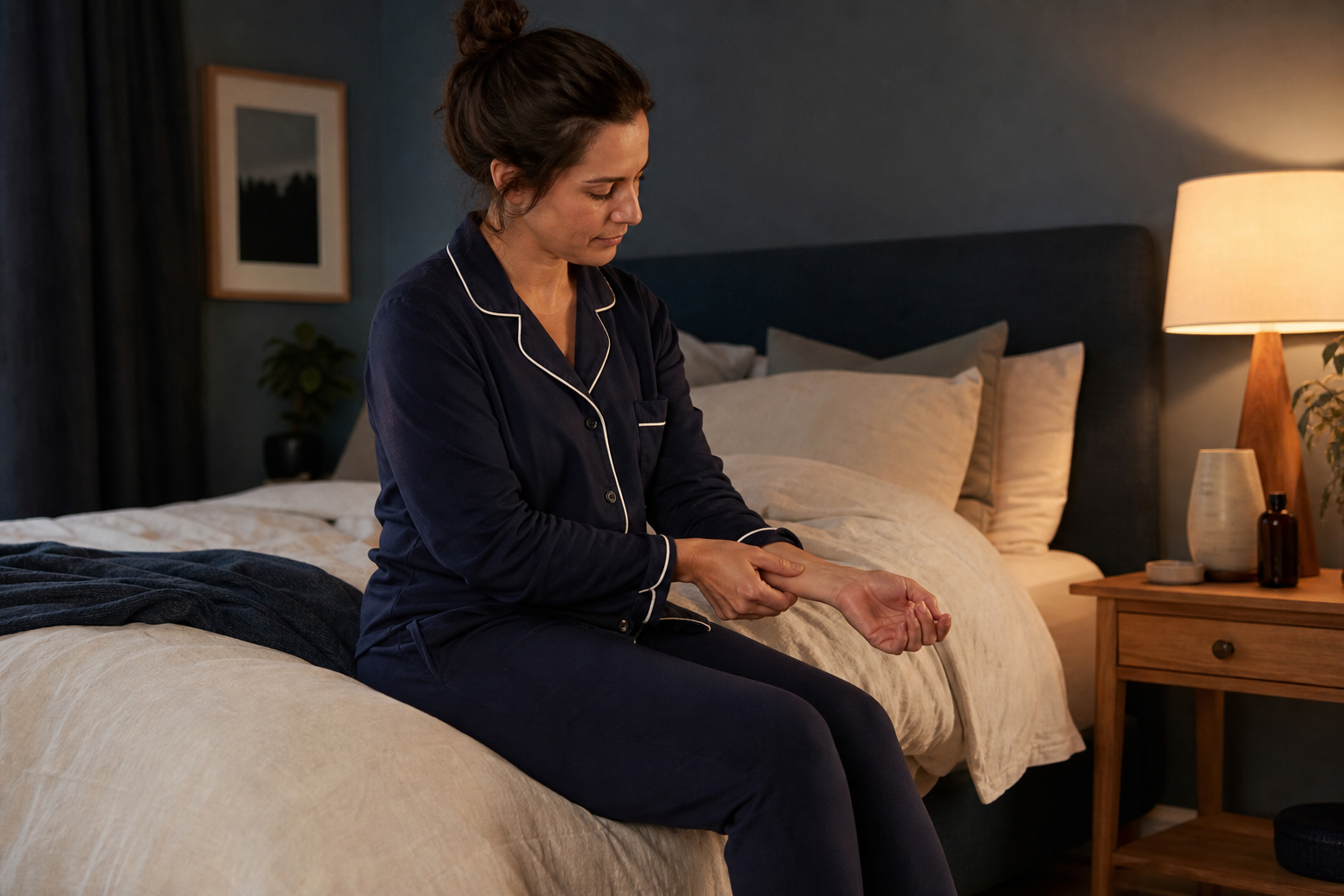
Three pressure points commonly used in sleep-focused or calming routines are Yin Tang between the eyebrows, HT7 at the inner wrist crease, and PC6 farther up the inner forearm. You can combine them into five minutes of gentle self-massage before bed.
Treat these pressure points for sleep as a relaxation ritual, not a switch that forces sleep. Research is mixed, and the exact routine below has not been clinically tested. Its practical value is giving you a quiet, screen-free transition into your usual bedtime routine.
Quick answer: Gently hold Yin Tang for 60 seconds, then HT7 and PC6 for about 45 seconds on each side. Use comfortable, nonpainful pressure. The landmarks, timing, and safety checks matter more than finding a millimeter-perfect spot or pressing hard.
What acupressure before bed can realistically do
Acupressure uses fingers or hands to hold or massage specific body locations. Some of these points are traditionally associated with calming or sleeplessness and are included in integrative self-care materials.
Several research reviews have reported improvements in self-rated sleep quality. In one systematic review, the main analysis included 13 trials and 968 adults, and HT7 appeared in most of the reviewed protocols. However, the studies varied considerably in their participants, point combinations, pressure, and session length. Many also had a high risk of bias.
Another review found improvement compared with control conditions but no clear advantage over sham acupressure, where participants received pressure at other locations. That leaves open the possibility that part of the experience comes from quiet touch, focused attention, expectation, reduced screen use, or simply taking a deliberate pause.
Most research protocols also repeated acupressure over days or weeks, often spending one to five minutes on each point. They do not prove that one five-minute session will make you fall asleep faster.
A realistic goal is simpler: notice whether acupressure before bed helps you feel quieter, less physically tense, and ready to continue toward lights-out.
How to find three pressure points for sleep
Individual anatomy varies. Finger-width measurements and tendon positions are approximate landmarks, not instructions to hunt for one perfect dot.
1. Yin Tang pressure point
Yin Tang is at the midpoint between the inner ends of your eyebrows. It is on the forehead, just above the top of the nose, rather than down on the bridge of the nose.
Place an index finger on this midpoint. You can hold it still or make very small circles. Relax your eyes and jaw instead of squinting or pushing your head into your finger.
This point is commonly used in calming routines. Its accessible location also makes it a convenient place to begin while your hands and shoulders settle.
2. HT7 pressure point
The HT7 pressure point, traditionally called Shenmen or Spirit Gate, is on the palm side of the wrist. Turn your palm upward and look at the wrist crease. Move toward the little-finger side and feel for a small hollow beside a tendon.
This is the wrist pressure point for sleep that appears especially often in sleep-focused acupressure research and self-care materials. That does not make HT7 a proven sleep switch.
The hollow may be more obvious on one wrist than the other. Use the crease, little-finger side, and nearby tendon as a general guide. Do not dig around until the area becomes sore.
3. PC6 pressure point
The PC6 pressure point is on the inner forearm rather than directly on the wrist crease.
Turn your palm upward. Place three fingers from your opposite hand across the forearm, starting at the wrist crease. PC6 is approximately three finger-widths above the crease, between the two central tendons.
If the tendons are difficult to see, gently flex your wrist to locate them and then let the hand relax before applying pressure. A general comfortable area between the tendons is enough for this wind-down exercise.
A gentle 5-minute bedtime wind-down routine
Prepare by putting your phone aside and getting into a supported position. You can sit against pillows or lie down as long as you do not strain your neck, wrist, or shoulder.
Use a thumb or index finger for each point. Hold still or make slow, small circles according to what feels more comfortable.
This 5-minute bedtime wind-down routine is an editorial sequence assembled from common point-location and pressure guidance. No located clinical trial validates this exact order or establishes five minutes as an effective treatment dose.
- 0:00 to 0:30: Settle
Let your hands rest loosely. Drop your shoulders away from your ears and unclench your jaw.
Take two or three comfortable breaths. There is no need for a demanding breathing count, unusually deep inhalations, or long breath holds.
- 0:30 to 1:30: Hold Yin Tang
Place one fingertip at the midpoint between the inner ends of your eyebrows. Apply light, steady pressure or make small circles for 60 seconds.
Keep your forehead, eyelids, and mouth soft. If touching your forehead feels irritating rather than calming, skip this point.
- 1:30 to 3:00: Press HT7 on both wrists
Turn one palm upward. Find the inner wrist crease on the little-finger side and rest your opposite thumb in the small hollow beside the tendon.
Press gently for about 45 seconds. Switch wrists and repeat for another 45 seconds. Let the hand being pressed remain loose rather than gripping or curling the fingers.
- 3:00 to 4:30: Press PC6 on both forearms
With one palm facing upward, locate the area approximately three finger-widths above the wrist crease, between the central tendons.
Hold or massage it for about 45 seconds, then change arms. Reduce the pressure if you feel tingling, numbness, or a sharp sensation.
- 4:30 to 5:00: Release and continue
Rest both hands. Notice whether your face, jaw, shoulders, or breathing feel any less tense. You do not need to decide whether the routine has “worked.”
Continue with your normal quiet bedtime routine. Avoid checking the clock or testing how quickly you can fall asleep, since that can turn a calming pause into another performance task.
How much pressure should you use?
Start softly and increase the pressure only until the contact feels noticeable and comfortable. Some areas may feel mildly tender or warm, but soreness is not proof that you found the correct point.
Use this simple self-check:
- Continue if the pressure feels steady, comfortable, and easy to tolerate.
- Ease off if you are tensing your face, hand, or shoulder to endure it.
- Stop for sharp pain, numbness, dizziness, skin changes, bruising, lingering tenderness, or another unusual symptom.
Pressing harder does not make the routine more effective. It is fine to use lighter pressure on one side or skip a point that is difficult to reach.
When to skip a point or ask a clinician first
Do not press over an open wound, rash, burn, blister, infection, significant swelling, severe bruising, fragile skin, or an area that feels numb. Avoid areas affected by a recent blood clot, recent injury, medical line, or device.
If you bruise easily, have low platelets or a clotting disorder, or take medication that substantially affects clotting, ask a healthcare professional what level of pressure is appropriate.
Pregnant readers should consult their obstetric provider or a qualified practitioner before adopting acupressure. This routine intentionally leaves out SP6 and LI4, which commonly carry specific pregnancy cautions, but individual guidance still matters.
If wrist pain, a brace, limited mobility, or a recent injury makes the arm points awkward, skip them. You can use only a comfortable forehead touch or choose another established relaxation practice. A wind-down method should not require you to strain.
Acupressure is not a substitute for insomnia care
Occasional bedtime tension is different from persistent insomnia. If sleep difficulty continues, causes substantial daytime impairment, or creates growing distress, discuss it with a qualified healthcare professional. Cognitive behavioral therapy for insomnia, or CBT-I, has much stronger guideline support for chronic insomnia than acupressure.
Seek medical advice for loud snoring, gasping or choking during sleep, breathing concerns, or substantial daytime sleepiness. These can be warning signs of sleep apnea or another condition that a pressure-point routine cannot evaluate or treat.
The most useful standard for this routine is not whether sleep happens on command. Use it only if five minutes of gentle touch helps you stop scrolling, soften physical tension, and move into bedtime with less effort.