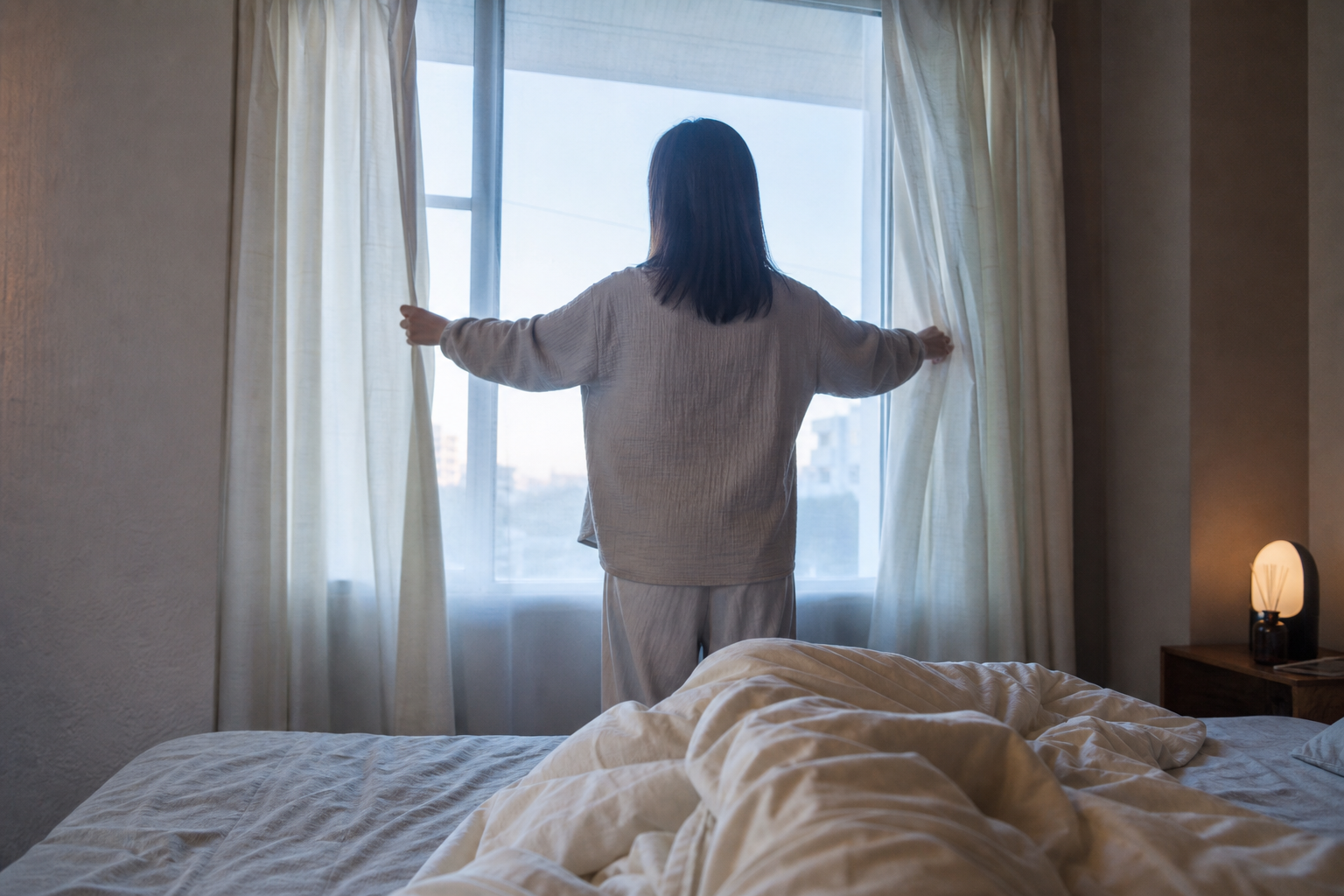
Morning light helps your internal clock recognize that the active part of your day has begun. When you regularly get daylight after waking, that signal can support morning alertness and help keep your sleep and wake times from drifting later. The effect depends on timing, brightness, season, your current schedule, and your individual response, so there is no single correct number of minutes for everyone.
Quick answer: Get into a bright environment soon after waking, preferably outdoors when practical. Repeat it consistently, protect your skin and eyes, and judge the routine by how your sleep timing responds.
Why morning sunlight and sleep timing are connected
Your circadian rhythm is an internal timing system that helps organize daily patterns of alertness and sleepiness. Light is one of its strongest environmental cues.
Specialized cells in your eyes detect environmental light and send timing information to the brain. Bright morning light generally tells your circadian system that daytime has started. For someone whose schedule is drifting late, this signal may gradually encourage earlier waking and earlier evening sleepiness.
That does not mean sunlight works like a sleeping pill. Morning light influences timing rather than making you immediately drowsy at night. It also cannot replace enough time in bed or correct a schedule that changes dramatically from day to day.
Timing matters more than chasing a perfect dose
Light can affect your internal clock differently depending on when you receive it. Light during your biological morning generally shifts circadian timing earlier, while bright light late in the evening can encourage later timing.
For a typical daytime schedule, a practical starting point is to seek light after getting out of bed rather than waiting until late morning. However, “morning” is relative to your sleep pattern. Someone waking at 5 a.m. has a different biological and environmental situation from someone waking at 10 a.m.
Brightness also varies widely. Outdoor daylight on an overcast morning may provide a stronger light signal than ordinary indoor lighting, while season, latitude, shade, and weather can all change the exposure. These differences are why a rigid minute target can be misleading.
Build a realistic morning light routine
The most useful routine is one you can repeat without turning it into a complicated project.
- Open your environment soon after waking. Raise the blinds, open curtains, and switch on available room lighting while you get ready.
- Move part of your morning outdoors. Drink your first beverage on a porch, take a short walk, check the garden, or complete another ordinary task outside. You do not need to face the sun.
- Use the brightest practical backup. On dark mornings or when going outside is difficult, spend time near a bright window or in a well-lit indoor area. Indoor light may be less intense, but it can still create a clearer contrast between morning and evening.
- Keep your wake time reasonably steady. Morning light works alongside your schedule. Large swings between workdays and days off can give your circadian system inconsistent timing cues.
- Reduce unnecessary brightness near bedtime. A bright morning is easier to distinguish when your evening environment becomes calmer and dimmer. Lowering room lights and avoiding intense screens close to bed can reinforce that contrast.
Consistency is usually more practical than pursuing an unusually intense exposure on occasional days.
Check whether the routine fits your goal
Pay attention to patterns over several days rather than judging one morning. Useful signs to track include:
- whether getting started in the morning feels easier
- whether your wake time becomes more consistent
- when natural evening sleepiness begins
- whether you are falling asleep earlier than you want
- whether late-night alertness is changing
If you already become sleepy very early and wake earlier than desired, deliberately increasing very early morning light may not match your goal. Shift workers, frequent travelers, and people with highly irregular schedules may also need more individualized light timing.
Keep in mind that caffeine, evening light, naps, activity, and changing bedtimes can blur the result. Adjust one or two habits at a time so you can tell what is helping.
Use daylight safely
Morning light exposure does not require staring at the sun. Look around your outdoor environment normally, and never look directly at the sun.
Continue to follow appropriate sun-safety practices. Depending on the UV level, weather, duration, and your skin sensitivity, that may include shade, protective clothing, sunscreen, a hat, and UV-blocking sunglasses. You do not need to skip sensible protection to receive a daytime light cue.
A light box is different from casual daylight exposure. Follow the current manufacturer instructions for placement, distance, and use. Ask a qualified professional before using bright-light therapy if you have an eye condition, take medication that increases light sensitivity, experience light-triggered migraines, or have a condition that can be affected by intense light.
The practical takeaway
Pair a fairly consistent wake time with a brighter start to your day. Outdoor daylight is useful when available, but the routine should remain flexible, safe, and suited to your schedule. If ongoing sleep difficulty, prolonged daytime sleepiness, or major schedule disruption continues despite reasonable habit changes, discuss it with a qualified healthcare professional.