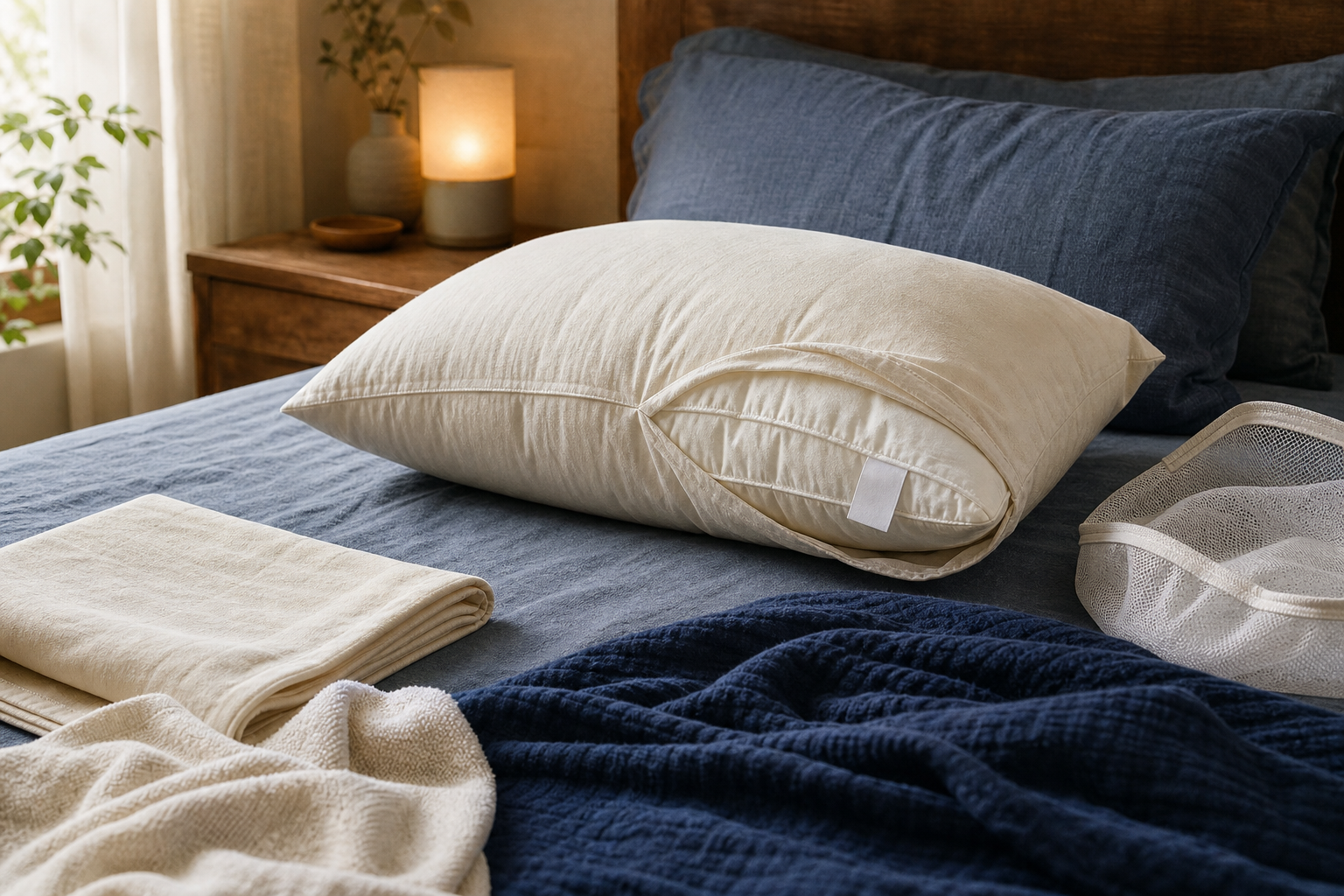
The safest way to clean pillows is to check the care label, remove and wash any separate cover, and use the gentlest method allowed for the filling. Many polyester and down pillows can be machine-washed, while solid memory foam and latex generally should not be submerged or put in a washing machine. Proper drying matters just as much as washing because trapped moisture can cause odors, clumping, or mildew.
Quick answer: Follow the pillow’s current care instructions. Machine-wash only when permitted, spot-clean solid foam and latex, and let every layer dry completely before remaking the bed.
Check the pillow before cleaning
Do not assume that two pillows with similar fabrics require the same care. Construction, adhesives, internal layers, and added cooling materials can change what is safe.
Start with these checks:
- Read the attached care label. Its instructions take priority over general advice.
- Identify every layer. A washable outer cover does not mean the inner pillow is washable.
- Look for tears or weak seams. Repair damage before machine-washing so filling cannot escape.
- Check for yellowing, odors, or dampness. These may require more drying time than routine surface cleaning.
- Assess the pillow’s condition. If the filling is deteriorating, crumbling, or permanently lumpy, washing may damage it further.
When the label is missing, take a conservative approach based on the filling. If you cannot identify the construction, contact the manufacturer or limit cleaning to the removable cover and careful spot treatment.
How to clean pillows by filling type
Polyester and other washable synthetic fills
Many synthetic-filled pillows are machine-washable, but verify the label first.
Use a mild detergent and the recommended water temperature. Avoid pouring detergent directly onto the pillow, since concentrated soap can be difficult to rinse from thick filling. If your machine allows it, choose a gentle cycle and an extra rinse.
A front-loading machine or top loader without a central agitator may place less stress on a bulky pillow. If using a machine with an agitator, position the pillow carefully and stop if it twists or bunches severely.
Down and feather
Some down and feather pillows can be washed, provided the label permits it and the shell has no holes. Use a small amount of mild detergent and a gentle cycle. Rinse thoroughly because detergent left among the feathers can encourage clumping.
Wet down is heavy and may smell different until completely dry. Drying can take several cycles. Pause periodically to separate clumps by hand and redistribute the filling.
Solid memory foam
Do not put solid memory foam in a washer or dryer unless the manufacturer explicitly says you can. Agitation can tear the foam, while dryer heat may damage its structure.
Instead:
- Remove and wash the separate cover according to its label.
- Vacuum the foam gently with an upholstery attachment if needed.
- Blot small marks with a cloth lightly dampened with water and a small amount of mild detergent.
- Blot again with a clean, barely damp cloth to lift residue.
- Air-dry the pillow flat in a well-ventilated area, away from direct heat.
Use as little liquid as possible. Saturated foam can take a long time to dry internally.
Shredded foam
Shredded-foam care varies considerably. Some pillows have a washable shell but filling that must be removed first. Others permit washing the assembled pillow or prohibit washing the fill entirely.
Follow the manufacturer’s instructions rather than applying solid-foam guidance automatically. Keep loose fill contained while removing it, and confirm that every component is completely dry before reassembly.
Latex
Solid latex generally should not be machine-washed, wrung, or tumble-dried. Clean the removable cover separately and spot-clean the latex only if its instructions allow. Blot gently and air-dry away from direct sunlight and heaters, which may degrade the material.
Dry the pillow all the way through
A pillow can feel dry at the surface while holding moisture in its center.
If tumble-drying is permitted, use the temperature stated on the label. Low or no heat is often the cautious option for washable fills. Pause to fluff the pillow, break apart clumps, and check for overheated areas.
For air-drying, lay the pillow flat on a clean, ventilated surface. Turn it periodically rather than hanging a heavy wet pillow by one edge. Before replacing the pillowcase, press several areas and check the center for coolness, dampness, compacted filling, or a musty smell.
If in doubt, allow more drying time.
Avoid common causes of damage
- Do not use bleach, fabric softener, hot water, or high dryer heat unless expressly permitted.
- Do not wring or sharply twist foam, latex, down, or delicate synthetic fill.
- Do not return a damp pillow to a protector or pillowcase.
- Do not scrub foam aggressively or soak it to remove one small mark.
- Do not wash a pillow with an open seam or failing inner liner.
- Do not rely on a universal washing schedule. Sweat, spills, protectors, climate, and construction all affect cleaning needs.
Between deeper cleanings, wash pillowcases regularly, clean removable protectors according to their labels, and air the pillow in a dry, ventilated room. These simpler steps reduce how often the filling itself needs cleaning.
A safe final check
Once dry, compare the pillow with its pre-wash shape. Gently redistribute washable loose filling and check for damp clumps, torn seams, crumbling foam, or a persistent musty odor.
The basic rule for how to clean pillows is simple: let the care label determine the method, use minimal force and moisture, and give the filling enough time to dry completely.