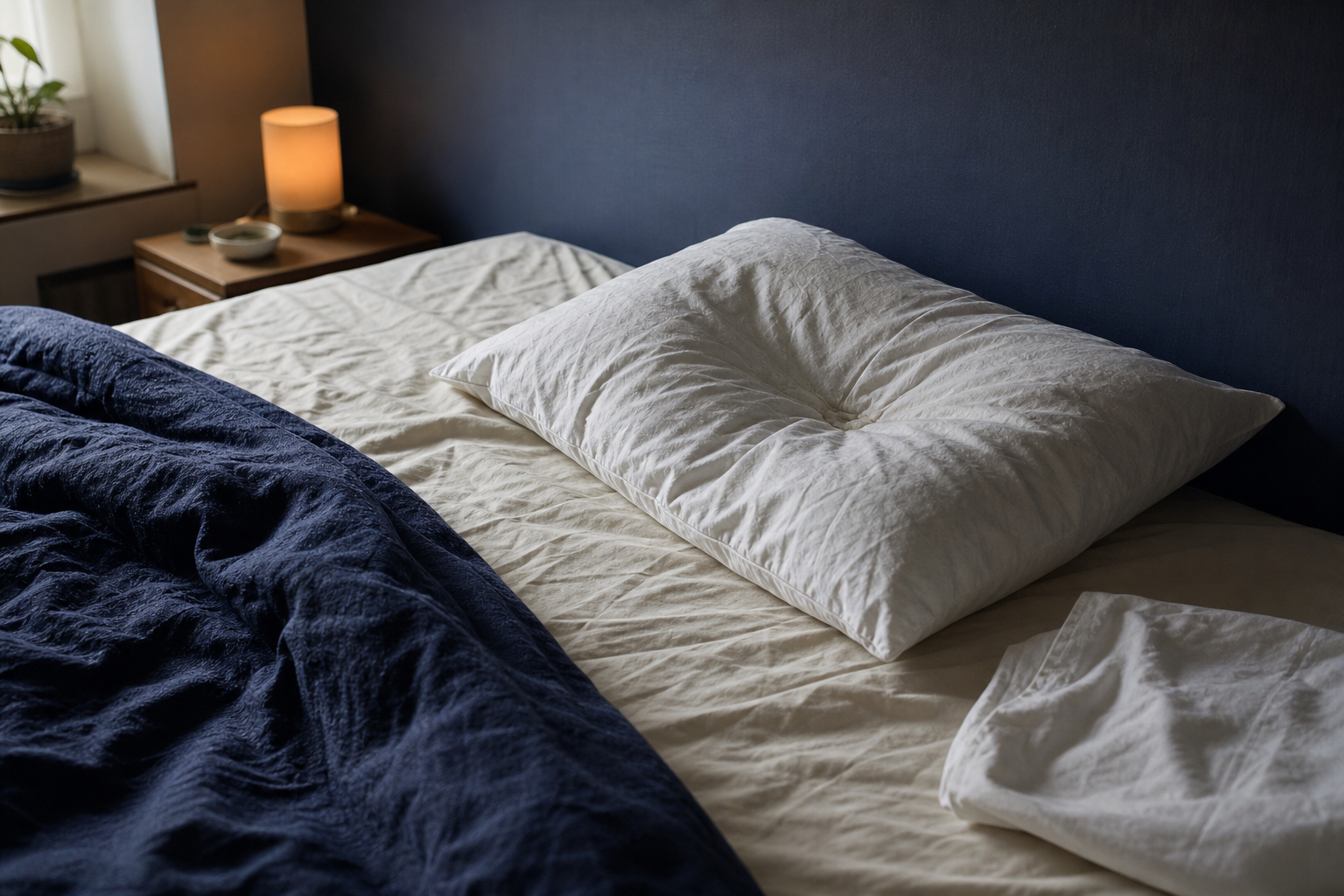
Knowing when to replace a pillow is less about following a fixed schedule and more about inspecting how it performs. Consider replacing yours when it no longer holds its intended shape, has damaged or uneven fill, retains an unpleasant odor after proper care, or no longer feels comfortable in your usual sleep setup.
Quick answer: Replace a pillow when cleaning, fluffing, or adjusting it no longer restores its shape, freshness, or comfort. Its condition is usually more useful than its age alone.
Use the following five signs to separate a pillow that needs routine care from one that has reached the end of its useful life.
1. It no longer regains its shape
A pillow gradually losing some loft does not always mean it needs immediate replacement. Many fiber, feather, and shredded-fill pillows are designed to be fluffed or redistributed.
Start with the refresh method allowed by the care label. This might include hand fluffing, gently redistributing adjustable fill, or using an approved dryer setting. Solid foam pillows require different care and should not be folded, washed, or placed in a dryer unless the manufacturer specifically allows it.
After refreshing the pillow, check whether it:
- returns to an even shape
- maintains enough height after you lie down
- develops a deep depression that remains during the day
- immediately collapses into the same flat area
If the pillow repeatedly flattens and no longer recovers, its fill may be too compressed to perform as intended.
2. The fill or foam is physically breaking down
Remove the pillowcase and washable protector so you can inspect the pillow itself. A clean outer case can hide wear in the core or inner shell.
With loose-fill pillows, look for hard clumps, permanently empty areas, or fill that cannot be redistributed evenly. With a solid foam pillow, check for deep tears, crumbling edges, splitting, or a lasting indentation.
Minor cosmetic changes are not automatically a reason to discard a pillow. The more useful question is whether the physical damage has changed how the pillow feels or responds under your head.
Do not pull apart a foam core or open a sealed pillow to investigate it. Follow the product’s construction and care instructions.
3. An unpleasant odor returns after proper care
Pillows absorb moisture and contact oils over time, even when they are protected by a pillowcase. Washing or airing may remove ordinary odors, but only if the pillow’s care instructions permit that method.
Follow the label carefully and let the pillow dry completely. Moisture trapped inside thick fill or foam can create a different problem than the original odor.
Replacement becomes reasonable when:
- the odor remains after approved cleaning and complete drying
- the smell disappears briefly but quickly returns
- the pillow smells persistently musty
- an odor appears after the pillow has stayed damp
A temporary scent from a new foam pillow is different from an old, recurring odor. Follow the manufacturer’s airing and expansion instructions for a new product before deciding that something is wrong.
4. Your usual setup is no longer comfortable
A pillow can look acceptable but stop feeling right. You may notice that you are constantly folding it, placing an arm underneath it, pushing fill into one area, or stacking another pillow on top.
Test it in your normal sleep position rather than squeezing it while standing. Your head and neck should rest in a comfortable, neutral-looking position without a strong upward or downward tilt.
Remember that pillow fit can change when you:
- switch your usual sleep position
- begin using a softer or firmer mattress
- add or remove a mattress topper
- experience a change in body proportions or preference
A softer mattress generally allows more body sink, reducing the space a pillow must fill. A firmer surface may leave more space around the head, neck, and shoulders. This means an intact pillow can become a poor match after another part of the sleep setup changes.
5. Repeated adjustments no longer fix the problem
Occasional fluffing is normal for many pillows. Rebuilding the pillow every night just to make it usable is a stronger sign of wear.
Try one deliberate reset using the approved care method. If the pillow is adjustable, confirm that the fill is distributed evenly and that none has escaped through a damaged seam. Then use the pillow for a few nights without introducing several other changes.
Consider replacement if you still cannot find a stable, comfortable arrangement or if the pillow changes shape almost immediately. Adding another pillow may temporarily change the height, but it can also make it harder to identify which part of the setup is not working.
Use age as a reminder, not a deadline
Materials, construction, use, cleaning, and moisture exposure all affect how long a pillow remains usable. A calendar estimate cannot account for those differences.
Instead of discarding a functional pillow on a particular anniversary, use its age as a reminder to inspect the core, seams, odor, loft, and comfort. Replace it sooner if it has visible mold, leaking fill, major structural damage, or contamination that cannot be cleaned and dried according to its instructions.
The practical rule is simple: keep a pillow while it remains intact, cleanable, and comfortable. Replace it when reasonable care no longer restores those qualities.
If a pillow setup causes new or worsening discomfort, stop using it. Persistent or severe pain, numbness, weakness, breathing concerns, prolonged daytime sleepiness, or ongoing sleep difficulty should be discussed with a qualified healthcare professional.