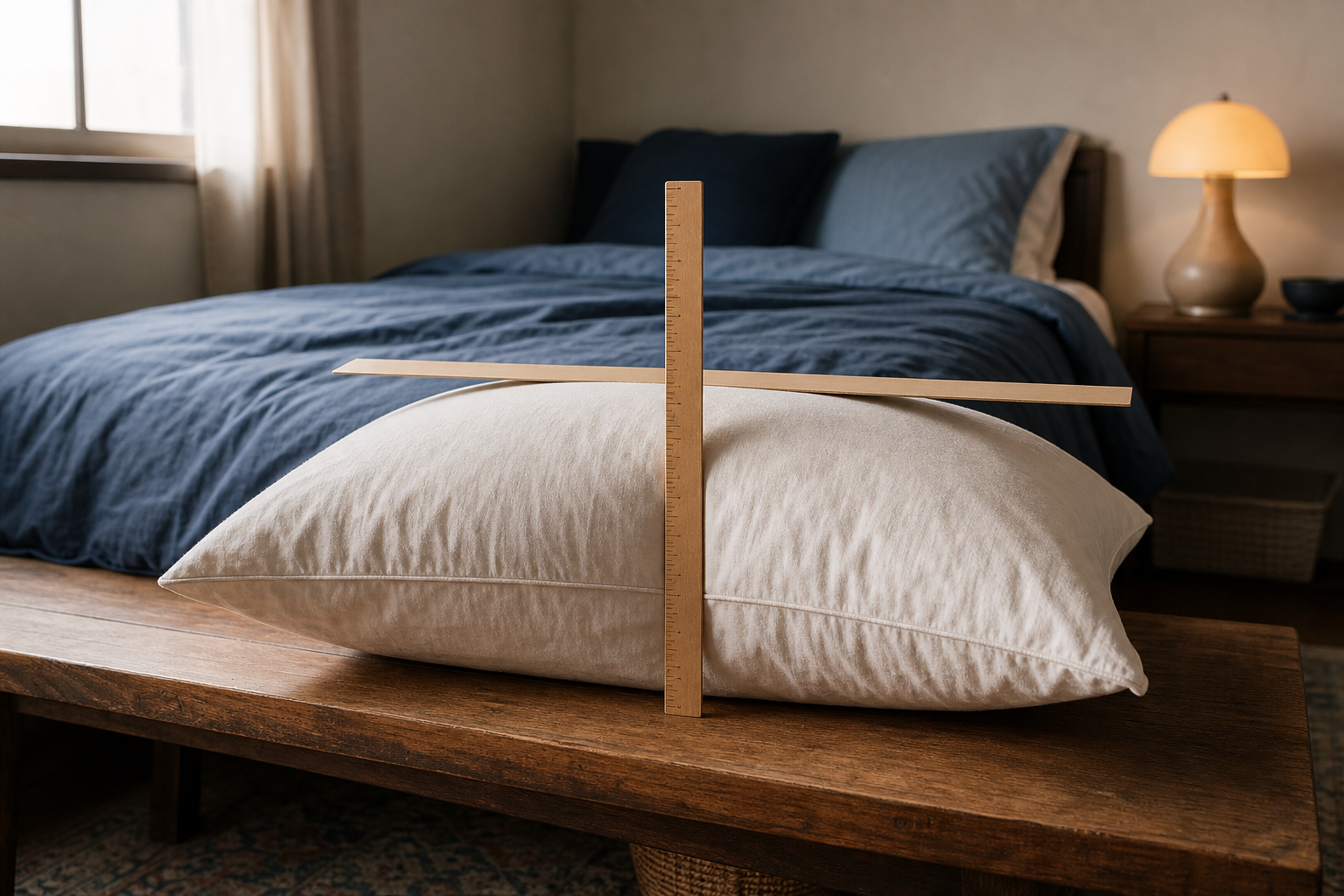
To measure pillow loft, place the fully expanded pillow on a hard, flat surface. Hold a ruler vertically beside its center, then use a lightweight straightedge across the highest point to read the height without pressing down. This gives you the pillow’s uncompressed loft.
That number is useful for comparing pillows, but it is not the pillow’s final height beneath your head. Compression, mattress sink, sleep position, and body proportions all affect the height you actually experience.
Quick answer: Measure an unweighted pillow from the flat surface to its highest central point, then test it on your actual mattress to judge its compressed, in-use height.
What You Need
Gather:
- A ruler or tape measure
- A second ruler, thin book, or lightweight piece of rigid cardboard
- A hard, level surface
- A notepad or phone for recording the result
Avoid using a heavy book as your top guide. Its weight can compress a soft pillow and make the measurement smaller than the pillow’s natural loft.
How to Measure Pillow Loft Step by Step
- Let the pillow reach its normal shape.
Fluff loose-fill pillows gently. If the pillow is new or was tightly packed, follow the manufacturer’s current expansion instructions before measuring it.
- Remove anything that changes its shape.
Take off decorative shams or tight protectors. You can leave on a normal, loose-fitting pillowcase if you want to measure the pillow as you use it.
- Place it on a hard surface.
A table or clean floor gives you a clearer starting point than a mattress, which may sink beneath the pillow.
- Choose the measurement point.
For a traditional pillow, measure near the center rather than at the seam. For a contour pillow, measure each usable ridge and the lower center separately. Check the manufacturer’s instructions for the intended orientation.
- Create a level top reference.
Hold the lightweight straightedge horizontally so it barely touches the pillow’s highest point. Do not push it down.
- Read the vertical height.
Measure from the hard surface to the underside of the straightedge. Record the result in inches or centimeters.
- Repeat the measurement.
Soft and adjustable pillows may not settle evenly. Measure two or three times after gently redistributing the fill, then record a small range if the results differ.
This number is the pillow’s uncompressed loft. It is the simplest repeatable measurement for comparing its height over time or against another pillow.
Uncompressed Loft Is Not Working Height
Two pillows can measure five inches tall and feel completely different once you lie down.
A soft down-alternative pillow may compress substantially, while a denser foam or latex pillow may retain more of its original height. Firmness, fill amount, pillow shape, and the size and weight of your head all influence the working height, meaning the height that remains while the pillow is in use.
You can estimate working height with help from another person:
- Put the pillow on your usual mattress.
- Lie in your normal sleep position for several minutes.
- Ask the other person to place a ruler beside the occupied portion of the pillow.
- Estimate the distance from the nearby mattress surface to the level where your head rests.
Treat this as an approximate observation, not a precise product specification. Measuring a soft, curved pillow while someone is lying on it is difficult. The comfort and position check matters more than getting an exact fraction of an inch.
Check the Loft on Your Actual Mattress
Your mattress changes how much space the pillow must fill.
On a softer mattress, your shoulder and torso may sink farther into the bed, often reducing the required pillow height. A firmer surface may leave a larger gap between your head and the mattress. A pillow that fits on one bed can therefore feel too tall or too low on another.
Sleep position also changes the starting point:
- Side sleeping: Often needs more working height to fill the shoulder-to-head space.
- Back sleeping: Commonly needs moderate height without strongly pushing the chin toward the chest.
- Stomach sleeping: Usually calls for less height because excessive lift can increase neck rotation or extension.
- Combination sleeping: May require a compromise or an adjustable pillow.
These are tendencies, not fixed rules. Shoulder width, body proportions, mattress sink, pillow compression, and personal comfort can shift the result.
Use a Simple Fit Check
Lie on the pillow in your usual position and let your body settle. Check whether your head looks and feels comfortably supported rather than noticeably tilted.
For side sleeping, your head should not drop sharply toward the mattress or angle upward toward the ceiling. On your back, notice whether the pillow forces your chin strongly toward your chest. If a setup produces new or worsening discomfort, stop using it and reassess the height, firmness, or orientation.
Record both numbers when comparing pillows: uncompressed loft and your rough working height. The first describes the pillow on its own. The second shows how it behaves as part of your complete sleep setup.
Persistent or severe pain, numbness, weakness, breathing concerns, prolonged daytime sleepiness, or ongoing sleep difficulty should be discussed with a qualified healthcare professional.